This Morning in the Garden: Is Rosehip Oil Good for Hair?
While deadheading roses in the front garden, a passing neighbour asked, “Is Rosehip oil good for hair?” A curious question for a Tuesday morning, perhaps—but within the flow of a conversation about the qualities of roses and their role in natural beauty, it made perfect sense. This happens when someone lingers near the gate and compliments the blooms. Approaching Midsummer in the UK, the garden is ablaze with hundreds of roses in soft shell pinks, lemon yellows, gentle oranges, luminous corals, and deep crimson reds. The display is breathtaking. Rose's essential oil captures her most refined gifts, but there’s something deeply grounding about working with the plant itself. At home, the petals are gathered and distilled in a small copper alembic still to create homemade organic rose water—a ritual of scent and stillness.
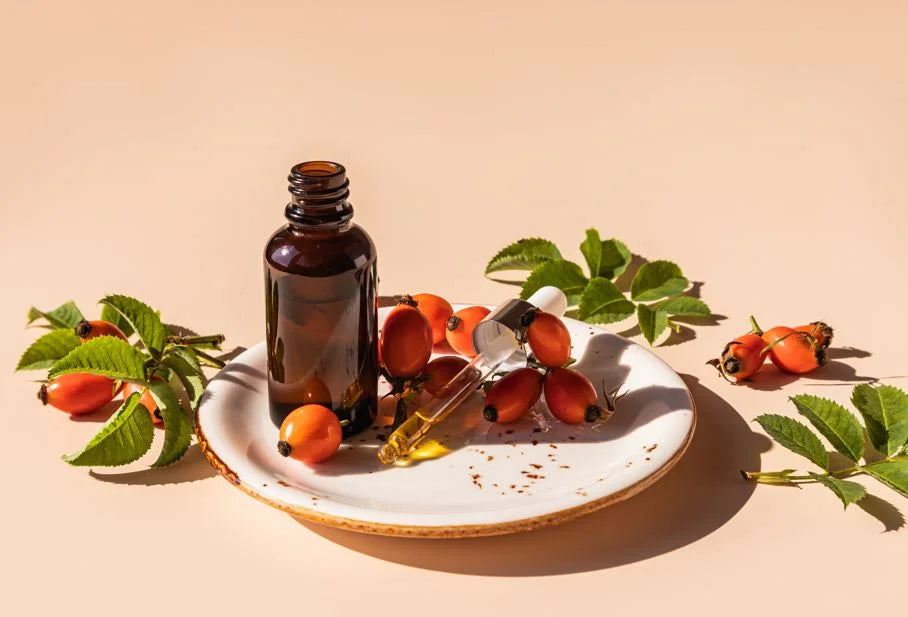
When harvesting, care is taken to leave the flower’s centre intact. This matures into a vibrant orange-red hip by autumn, offering a second crop, rich in Vitamin C and full of healing potential. From these hips come seeds, and from the seeds, an oil like no other. Rosehip seed oil is dense with antioxidants and regenerative properties—so potent it must be used sparingly on the skin. So, is Rosehip oil good for hair? It’s worth exploring.
What Is Rosehip Oil?
 Before we go any further, let’s clear up a common internet myth. There is no such thing as Rosehip essential oil. It’s not an essential oil. Rose essential oil (Rosa damascena) is distilled from the petals. Rose leaf essential oil comes from the plant’s leaves. But Rosehip seed oil is extracted from the seeds inside the fruit—or “hip”—that forms at the base of the flower after the petals fall. As autumn approaches, the hip swells and ripens, turning from green to a vivid orange-red. This oil, usually cold-pressed from the seeds of Rosa canina, is known as Rosehip Seed carrier oil. It’s a carrier oil, not an essential oil, and can be used similarly to Jojoba or Argan oil. There’s also a CO₂-extracted version of Rosehip oil. Each method has its advocates, and it’s worth trying both to see which suits best. The cold-pressed variety remains a favourite here, especially the one stocked by VINEVIDA, which is known for its high quality and purity. Ultimately, choose the type that meets your needs. Don’t confuse this with Rosehip extract, which usually refers to the dried, powdered fruit and seeds. Sold as a health supplement in capsules or powder, it’s a different product entirely. Now that the groundwork is clear, let’s explore what Rosehip Seed carrier oil actually does.
Benefits of Rosehip Oil For Hair
 Yes, you're here to find out “Is Rosehip oil good for hair?”—but understanding its skincare benefits first gives a much clearer picture.
Start with the first part of Rosehip Oil Benefits: Sublime Serum, Cream Mask & Moisturiser Recipes, which lays a strong foundation. It explores how Rosehip oil supports the skin and introduces key concepts like fatty acids and antioxidants, both of which are crucial to its power. Take a close look at the mass spectrometry table. It shows exactly which fatty acids and antioxidants Rosehip oil contains—and how we can use them where they’re needed most, whether that’s the skin or the scalp.
Is Rosehip Oil Good For Hair? - The Research
Yes—absolutely. And science increasingly supports its role in strengthening, protecting, and even promoting hair growth. Truong (2023) observed “remarkable” results when applying Rosehip oil to mice, compared to the control group. Demir (2023) reported a significant improvement in tensile strength, meaning hair became more resistant to breakage. Kim (2024) explored the effects of Rosa rugosa flower water, not even the oil, and found it stimulated hair follicle growth, increased follicle numbers, and enhanced hair thickness. It worked by boosting growth-promoting factors and suppressing those that inhibit it. That’s just from the flower water. Imagine what the seed oil can do.
Rosehip Oil for Hair: What Effects Can I Expect?
When we start using Rosehip oil for hair care, we want to know what it is going to do for us and what we can expect from it. We know it’s great for hair and skin, but let’s explore why it is so great.
Will Rosehip Oil Work for My Hair Type?
 Rosehip oil combines a handful of different benefits for your hair, and it can be used on all hair types to promote better hair and scalp health.
So, if you have:
-
-
Colored or damaged hair
-
Curly hair
-
Normal or natural hair
-
Brittle hair
-
Frizzy hair
-
Oily hair
-
Fine hair
-
You can use Rosehip oil as part of your regular skin and hair care routines to promote healthier hair and scalp. If you asked, is Rosehip oil good for hair types like mine? Yes! Go right ahead and use it.
Is Rosehip Oil Good For Hair & Scalp Health?
Rosehip oil’s anti-inflammatory properties help soothe scalp irritation by supporting the skin’s natural barrier function. When combined with its powerful antioxidants, Rosehip oil can ease common scalp issues like dandruff, dryness, and itching by strengthening this all-important protective layer. A healthy scalp lays the groundwork for healthy hair growth. By protecting and stimulating hair follicles, Rosehip oil supports both the condition of the scalp and the strength of growing hair. So, is Rosehip oil good for hair and scalp health? Absolutely. Add it to your regimen today.
Is Rosehip Oil Good For Hair Growth?
Is Rosehip oil good for hair growth?
The science says yes, and so do countless users who swear by its results in their daily routines. Its active compounds nourish and protect both the scalp and hair follicles—actions that support overall hair health and encourage natural growth. Though most of the studies so far involve mice, the research consistently points to Rosehip oil’s ability to stimulate new follicle growth, strengthen existing follicles, and improve the growth rate and quality of the hair shaft. The only way to know if it works for you is to try it—consistently—for 60 to 90 days. Want to supercharge the results? Pair Rosehip with essential oils.
Read more:- Boost Hair Growth Naturally: Top Essential Oil Recipes.
Is Rosehip Oil Good For Hair Strength?
 We can harness Rosehip oil’s natural properties to nourish and moisturise the hair shaft, making strands stronger and less prone to breakage during daily wear and tear, such as washing, brushing, or styling. One of the key components, linoleic acid, helps improve hair elasticity. Increased elasticity means fewer split ends, less breakage, and better resistance to damage, making Rosehip oil an ideal choice for anyone struggling with fragile or weakened hair. Hair that’s nourished and supported at the shaft may also appear fuller, thicker, and more voluminous, especially in finer hair types. At the very least, it improves texture and feel. These beneficial compounds may also reduce hair loss, though consistency is key. Regular application is essential to support both hair and scalp health, which work hand-in-hand to prevent thinning. So, is Rosehip oil good for hair strength?
Yes—and the research above backs it up.
Is Rosehip Oil Good For Hair Shine and Smoothing?
 Rosehip oil can enhance the shine, softness, and smoothness of hair. Its natural radiance-boosting effect makes hair look healthier and more luminous.
That’s why it appears so frequently in hair oil blends and commercial treatments, especially those designed to protect against heat damage from drying, curling, and straightening. There are multiple benefits for both hair and scalp when Rosehip oil becomes part of a routine. Try it for visible improvement and a healthier, more balanced scalp.
In short, the essential fatty acids and antioxidants in Rosehip oil can help:
-
-
Improve all hair types
-
Soothe and calm the scalp
-
Support the skin’s barrier function
-
Promote new hair growth
-
Potentially reduce hair loss
-
Improve hydration
-
Strengthen and nourish the hair shaft
-
Minimise damage
-
Leave hair smooth, shiny, and radiant with health
-
How To Use Rosehip Oil For Hair
We’ve covered what Rosehip oil can do—now here’s how to use it effectively.
How Much Rosehip Oil Can I Use?
Is Rosehip oil good for hair when used at full strength? Yes—but context matters. This carrier oil is incredibly potent, rich in essential fatty acids and antioxidants. On facial skin, it's typically used at around 10% in a blend. But for hair, it can be applied neat to the strands, especially on dry or split ends.
For a holistic approach, Rosehip oil can be incorporated into daily or weekly rituals—but it doesn’t need to be used at full strength every time. It pairs beautifully with other powerhouse oils like Argan and Castor.
A few basic guidelines:
-
-
Tiny amounts (e.g., to tame ends or add shine): Use neat.
-
Overnight smoothing treatments (e.g., a teaspoon): Go 50/50 with another oil.
-
Warm oil treatments (e.g., 50ml blend): Use Rosehip as less than half, combined with oils like Grapeseed, Argan, or Coconut MCT.
-
How Should I Apply Rosehip Oil to My Hair and Scalp?
Root to tip? Absolutely. Scalp too? Yes—just with a little balance.
The scalp is skin, so it’s worth being mindful of concentration. Try using 25% Rosehip or less; if it feels too rich, reduce it to 10%. Dilute into lighter oils like Grapeseed or Coconut MCT to avoid greasiness. Massage the diluted blend into the scalp to support barrier function, soothe irritation, and help keep hair follicles healthy and active. For a finishing touch, use Rosehip oil as a spot treatment to smooth flyaways, control frizz, add gloss to split ends, and leave hair looking polished and vibrant. A small travel bottle in your handbag can work wonders for on-the-go touch-ups, leaving your hair glowing with health all day.
When to Apply Rosehip Oil – Wet or Dry Hair? Does Rosehip Oil Work on Both Wet and Dry Hair?
Yes—Rosehip oil is beneficial for both wet and dry hair. The key lies in how you use it, not whether the hair is wet or dry. You can tap into the benefits of Rosehip oil regardless of moisture level, but tailoring your method to your hair’s needs will yield the best results. For very dry or brittle hair, a warm oil treatment works beautifully. Apply the oil to damp hair, then wrap it in a hot towel and leave it to absorb for at least 20 minutes before rinsing out with your usual shampoo. For deeper nourishment, you might choose to leave it on overnight. As a spot treatment, Rosehip oil can also be rubbed between the palms and smoothed onto the ends of dry hair. Blending it with Grapeseed oil adds extra shine, perfect as a finishing touch after styling.
Is Warm Rosehip Oil Good For Hair?
Warmed Rosehip oil? Absolutely—just don’t overdo it. Gently warming the oil (to just above room temperature) helps it penetrate the hair shaft more deeply, making it especially effective for very dry or damaged strands. Just avoid overheating—it can degrade the oil’s active components. The safest method? Place a small bowl of Rosehip oil inside another bowl of hand-hot water and allow it to warm gradually. Think like Goldilocks: not too hot, not too cold—just right.
The Power of Rosehip Oil for Hair - Plus Homemade Recipes
Still wondering if Rosehip oil is good for your hair? The best way to find out is to try it for yourself. This is the most empowering part—rolling up your sleeves, exploring beautiful natural ingredients, and crafting your own bespoke hair care treatments. Hair products on the high street often contain undesirable ingredients like SLS, phthalates, and parabens. Learning to blend your own allows you to take control, not just of your hair’s health, but of your overall well-being. Explore the recipes below, get hands-on, and discover how Rosehip oil can become a trusted staple in your hair ritual. (Discover more)
By being able to choose natural ingredients to create your own bespoke hair treatments, you are simply going to improve your hair health and your overall well-being at the same time.
Rosehip Hot Hair Oil
 Yes, “hot oil” is the term most people recognise—but let’s be clear: it’s warm, not hot. That gentle heat helps Rosehip oil work its magic, without compromising its powerful properties. Still wondering, “Is Rosehip oil good for my hair?” This is one of the best ways to find out—apply it, experience it, and feel the difference in your scalp and strands. The recipe is super simple to make. It’s been paired with other powerhouse carrier oils and essential oils to deliver visible results—and it smells divine, rich with floral notes. If you prefer a more masculine scent profile, try blending in Rosemary and Sandalwood—but do check their safety guidelines first to ensure they’re suitable for your personal use.
You Will Need:
-
-
Measuring jug
-
Stainless steel spoon
-
Bottle funnel
-
100ml Dark glass bottle and lid
-
Oil and waterproof label
-
Ingredients:
-
-
25 ml of Rosehip carrier oil (Rosa Canina)
-
25 ml of Argan carrier oil (Argania Spinosa)
-
25 ml of Castor carrier oil (Ricinus communis)
-
25 ml of Jojoba carrier oil (Simmondsia chinensis)
-
30 drops of Rose Geranium essential oil (Pelargonium Roseum X Asperum)
-
20 drops of Lavender essential oil (Lavandula angustifolia)
-
10 drops of Ylang Ylang essential oil (Cananga odorata)
-
Optional: Preservative of your choice, follow the manufacturer's instructions.
Safety:
-
-
Do not use it in the first 37 weeks of pregnancy
-
Rinse well if it gets in your eyes with clean, tepid water. If irritation persists, seek immediate medical attention, taking the clearly labelled bottle with you.
-
Method:
So simple. Just combine it all and decant into the bottle using a funnel to keep the bottle clean and oil-free. Add a label, listing all ingredients and safety advice. Add a date and an expiry date of 3-6 months.
How To Use:
-
-
Always do a 24-48 hour patch test before you first use it. Even if you just plan to use it on your hair, it may get on your scalp, so best to be safe than sorry.
-
Warm & Apply The Oil
-
-
Set a bowl of hot water where you plan to use your oil. Carefully float another small bowl in the water and pour in your hair oil blend.
-
Allow the oil to warm through for about 5 minutes.
-
While the oil warms, run some water through your hair to dampen it. Then towel dry off any excess; you only want mildly damp hair.
-
Then apply the oil throughout your hair, working from the root, distributing the oil to the ends of your hair.
-
Work the oil into your scalp too, remembering that it helps restore and protect the skin's barrier function and can be very soothing. It pays to add oil to your scalp and massage it in well, and also boost the circulation to promote growth.
-
Hot Towel
-
-
Once you have covered your hair and scalp from root to tip, wrap your hair in a hot towel and leave the nourishing oil to penetrate the hair. Allowing deep penetration is best for repairing damaged hair and moisturising and nourishing dry hair strands. I suggest leaving it on for at least 20-30 minutes. You can leave it on overnight if you wish, but protect your bed linen from oil staining.
-
Rinse The Oil Out
-
-
Rinse with warm water and your normal shampoo; you may need a second application to remove all excess oil. Condition, dry and style as normal.
-
Marvel at the results! Introducing and applying Rosehip oil into your hair care routines regularly helps you reap the benefits more readily and have healthy hair and scalp, radiant shine, and sleek, glossy locks.
-
Rosehip Hair and Scalp Mask For Dry Hair and Skin
 Ha! Wait until you try this one—you’ll be shouting it from the rooftops. This is, without doubt, the best Rosehip oil hair mask I’ve ever used (even if I do say so myself). It’s a brand-new recipe, created just for you—and I’ve been trialling it personally for about a month now, with excellent results. My hair had been getting thinner, and since using this mask, it feels noticeably thicker, has more volume, and is far less frizzy. I’ve also gained a welcome boost in shine and gloss. The recipe focuses on boosting the fatty acid content of Rosehip oil by combining it with cosmetic butters and other carrier oils, creating a rich, unctuous mask that deeply nourishes both scalp and strands. To enhance its protective power, I’ve built on Rosehip oil’s natural antioxidants by adding essential oils known for guarding against UV rays and environmental stressors. The scent? Woody and spicy, with a gorgeous fragrance that lingers on the hair.
Want to swap the essential oils for fragrance oils? Go for it—just be sure to check the IFRA safety guidelines first.
I love it. I hope you do too.
You Will Need:
-
-
Double boiler
-
Heatproof mat
-
Stainless steel spoon
-
Measuring jug
-
Mixing Bowl
-
300ml wide-mouth jar and scoop
-
Oil and waterproof label
-
Ingredients:
-
-
¼ cup of Rosehip carrier oil (Rosa Canina)
-
½ cup of Jojoba carrier oil (Simmondsia chinensis)
-
¼ cup of Shea Butter (Butyrospermum parkii)
-
¼ cup of Cocoa Butter (Theobroma cacao)
-
40 drops of Cardamom essential oil (Elettaria cardamomum)
-
30 drops of Patchouli essential oil (Pogostemon cablin)
-
30 drops of Cedarwood (Himalayan) essential oil (Cedrus deodara)
-
Optional: Preservative of your choice, follow the manufacturer's instructions.
TOP TIP: It is worth having a bit more carrier oil on hand, in case you want a softer consistency at the end.
Safety:
-
-
Do not use it in the first 16 weeks of pregnancy
-
Rinse well if it gets in your eyes with clean, tepid water. If irritation persists, seek immediate medical attention, taking the clearly labelled bottle with you
-
Method:
Warming The Butters
-
-
Just like your Rosehip oil, we don’t want to heat cosmetic butters more than we have to, so low and slow is the way to go here.
-
First, dilute your essential oils into your carrier oils and mix well.
-
Set your double boiler over a low to medium heat, making sure the top pan does not touch the water in the bottom pan. Allow to pre-warm for a few minutes.
-
Chop your cosmetic butters into small chunks to speed up the process and place them in the top pan of the double boiler. You can stir to help them along if you wish.
-
Cooling & Mixing
-
-
As soon as they are molten, remove from heat, separate the top pan from the water, and set on a heatproof mat to cool a little.
-
Pour the molten butters into a mixing bowl and then add your carrier oils mixed with the essential oils and stir to mix thoroughly. It takes longer than you think, so spend a good few minutes on it. If you use an electric mixture, you will introduce air, and it probably won’t all fit in your jar ... and it will sink back in the jar as the air escapes.
-
You can now do one of two things: you can let the mask ‘set’ in the bowl if you want to check its consistency and make any adjustments, like adding more carrier oil to soften it off.
-
Bottling & Labeling
-
-
Alternatively, you can simply pour it into a wide-mouth jar, cover it with a soft, clean cloth, and let it set up and cool completely.
-
You want the Rosehip Hair Mask to be cooled before shutting the lid, as warmth and moisture can encourage the formation of mould and bacteria. We can avoid introducing bacteria from our fingers by using a scoop or spoon to remove the mask from the jar, too.
-
Once cool, add the lid and a label listing all ingredients and safety precautions. Add a date and an expiry date of 3-6 months.
-
How To Use:
-
-
Always do a 24-48 hour patch test before you first use it because this will touch your scalp.
-
Use a scoop and scoop some of the mask into your hand.
-
Ideally, apply it to slightly damp hair, but you can also apply it to dry hair if you wish.
-
Take your time and run it from root to tip, and pay attention to any damaged ends or areas that need attention.
-
Once your hair is covered, work it into your scalp and get the circulation going to stimulate blood flow and hair follicles and to improve skin cell regeneration.
-
Wrap in a very hot towel for at least 20-30 minutes, ideally up to an hour. Yes, again, I did a couple of my treatments overnight too.
-
Squeeze any excess mask from the hair; combing it through can help with this. If you pop it into a paper tissue, you can simply compost the excess.
-
Then wash your hair, using your normal shampoo; you may need two applications.
-
Condition, dry, and then style as normal.
-
Admire your gorgeously soft, shiny hair that will be glowing with vitality and health.
-
Rosehip Dry Oil for Taming Frizz and Flyaways

This is such a simple, natural way to use Rosehip oil for hair health and styling. You’ve seen the benefits—now here’s a recipe that puts them into action. Just a few drops applied to the ends of your hair can help tame frizz, smooth curls and flyaways, and support the repair of damaged strands. Rosehip oil penetrates the hair, reducing breakage and offering protection from UV rays and environmental stressors. Adding this nourishing oil to your holistic hair care routine supports dry hair and promotes health across all hair types. This blend is rich in Rosehip oil, so reserve it for the hair strands only—not the scalp. To extend your skills, I’ll share a handful of blends using both essential oils and fragrance oils in this Rosehip Dry Oil base—perfect for exploring new combinations and enhancing your blending techniques.
You Will Need:
-
-
Small measuring jug
-
Bottle funnel
-
50ml rubber-topped dropper bottle
-
Oil and waterproof label
-
Rosehip Dry Oil Base Ingredients:
Use the full amount of Coconut MCT oil if you are not adding essential oils or fragrance oils.
-
-
22.5 - 25 ml of Coconut MCT carrier oil (Cocos nucifera)
-
20 ml of Rosehip carrier oil (Rosa Canina)
-
5 ml of Castor carrier oil (Ricinus communis)
-
Optional: Preservative of your choice, follow the manufacturer's instructions.
| Rosehip Dry Oil Blends | ||
|---|---|---|
| Essential Oil Blends | ||
| Protect and Repair | Moisturizing | Balancing |
|
10 drops of Frankincense essential oil (Boswellia serrata) 10 drops of Cedarwood essential oil (Cedrus deodara) 10 drops of Roman Chamomile essential oil (Anthemis nobilis L.) |
20 drops of Rose Geranium essential oil (Pelargonium Roseum X Asperum) 10 drops of Geranium essential oil (Pelargonium Graveolens) |
15 drops of Grapefruit essential oil (Citrus paradisi) 10 drops of Mandarin essential oil (Citrus reticulata) 5 drops of Ylang Ylang essential oil (Cananga odorata) |
| Safety: | Safety: | Safety: |
| Do not use it in the first 16 weeks of pregnancy. | Do not use it in the first 16 weeks of pregnancy. |
Do not use it in the first 16 weeks of pregnancy. Grapefruit Specific: Not suitable for use by people who have platelet disorders or are on blood-thinning medication. It is suggested you cease use of grapefruit essential oil 48 hours before any planned surgery |
| Essential Oil & Fragrance Oil Blends | ||
|
Following the maximum skin safety dilution rates in IFRA category 7B Use Soaps & Candles fragrance oils |
||
| Floral Blend | Citrus Blend | Woody Blend |
|
1 ml of NO. Violet's fragrance oil 5 drops of Lavender essential oil (Lavandula angustifolia) 5 dr ops of Ylang Ylang essential oil (Cananga odorata) |
7 drops of NO. 3114 - Inspired by: Mandarino di Amalfi by Tom Ford fragrance oil 20 drops of Mandarin essential oil (Citrus reticulata) 3 drops of Cardamom essential oil (Elettaria cardamomum) |
1 ml of NO. 21 - Cedarwood & Amber fragrance oil 5 drops of Amyris essential oil (Amyris Balsamifera) 5 drops of Copaiba essential oil (Copaifera officinalis) |
| Safety: | Safety: | Safety: |
| Do not use it in the first 37 weeks of pregnancy. | Do not use it in the first 16 weeks of pregnancy. | Do not use it in the first 16 weeks of pregnancy. |
| Fragrance Oil Blends | ||
|
Following the maximum skin safety dilution rates in IFRA category 7B Use Soaps & Candles fragrance oils |
||
| Fresh and Bright | Smooth and Sophisticated | Playful and Alluring |
|
1 ml of NO. 48 - Lemon Verbena fragrance oil 1.5 ml of NO. 57 - Orange Sherbet fragrance oil |
14 drops of NO. 80 - Fleur De Vanille fragrance oil 6 drops of NO. 74 - Mystic Oud fragrance oil |
2 ml of NO. 1601 - Inspired by: Love Spell by Victoria's Secret fragrance oil 7 drops of NO. 35 - Fruit Loops fragrance oil |
Overall Safety:
-
- If it contains essential oils, check the individual safety information above regarding pregnancy.
- Do not apply to the scalp.
- Rinse well if it gets in your eyes with clean, tepid water. If irritation persists, seek immediate medical attention, taking the clearly labelled bottle with you.
Method:
This is as simple as mixing all the ingredients and decanting them into the bottle using a funnel. Label clearly listing all ingredients and safety information. Add a date and a 3-6 month expiry date.
How To Use:
-
- Always do a 24-48 hour patch test before you first use it.
- Dispense a couple of drops of Rosehip Dry Oil into your palms and rub the oil between your palms and fingers.
- Then work your hands through your hair strands, distributing the oil where you need it most.
- Pay particular attention to any dry or damaged ends.
- You can always brush this through your hair if you feel it necessary.
- There is no need to rinse this oil off; it will simply absorb, so simply style as normal.
- It’s so simple to achieve fabulous hair with this little magical wonder.
The Final Word
Still asking, “Is Rosehip oil good for hair?” You already know the answer. By now, it’s clear—Rosehip oil is fantastic for your hair. Its benefits are wide-ranging and effective, helping you achieve softer, shinier, healthier hair full of natural vitality.
Use Rosehip Oil To:
-
- Soothe irritation and inflammation linked to scalp conditions like dandruff, psoriasis, and eczema
- Improve the skin’s barrier function, protecting both scalp and follicles
- Nourish follicles, stimulate new growth, and guard against hair loss
- Boost hydration, strengthening the hair shaft, ft, and reducing damage
- Protect hair from UV rays, pollution, and environmental stressors with high levels of antioxidants
- Smooth the hair, adding lustre and shine for a radiant, healthy finish
- Support all hair types, whether dry, curly, brittle, oily, or damaged—Rosehip oil helps balance, nourish, and strengthen
Have fun with the recipes—try the Warm Hair Oil, the Rosehip Hair and Scalp Mask, or create your own Rosehip Dry Oil to tame frizz and flyaways. Experiment with blends, and remember to follow the IFRA Category 7B safety guidelines. When in doubt, the VINEVIDA Calculator is there to help. Is Rosehip oil good for hair?
You bet your bottom dollar it is. Try it today and see the difference.