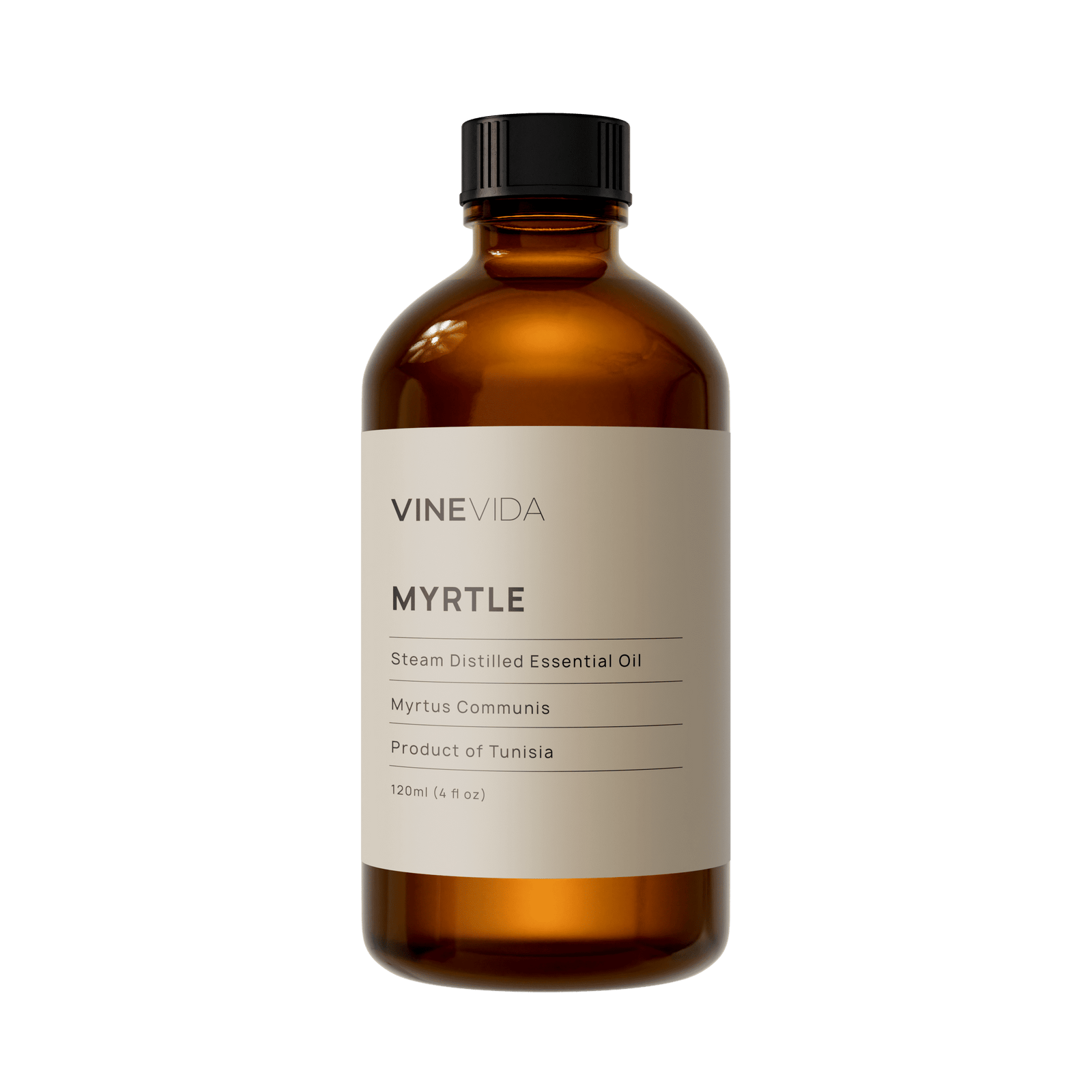




Note: Before we start, there has been a huge boom in the number of Essential Oils coming out of Australia, called myrtles, honey myrtle, lemon myrtle, pineapple myrtle… It should be noted that these should not be confused with the common garden Myrtle Essential Oil.
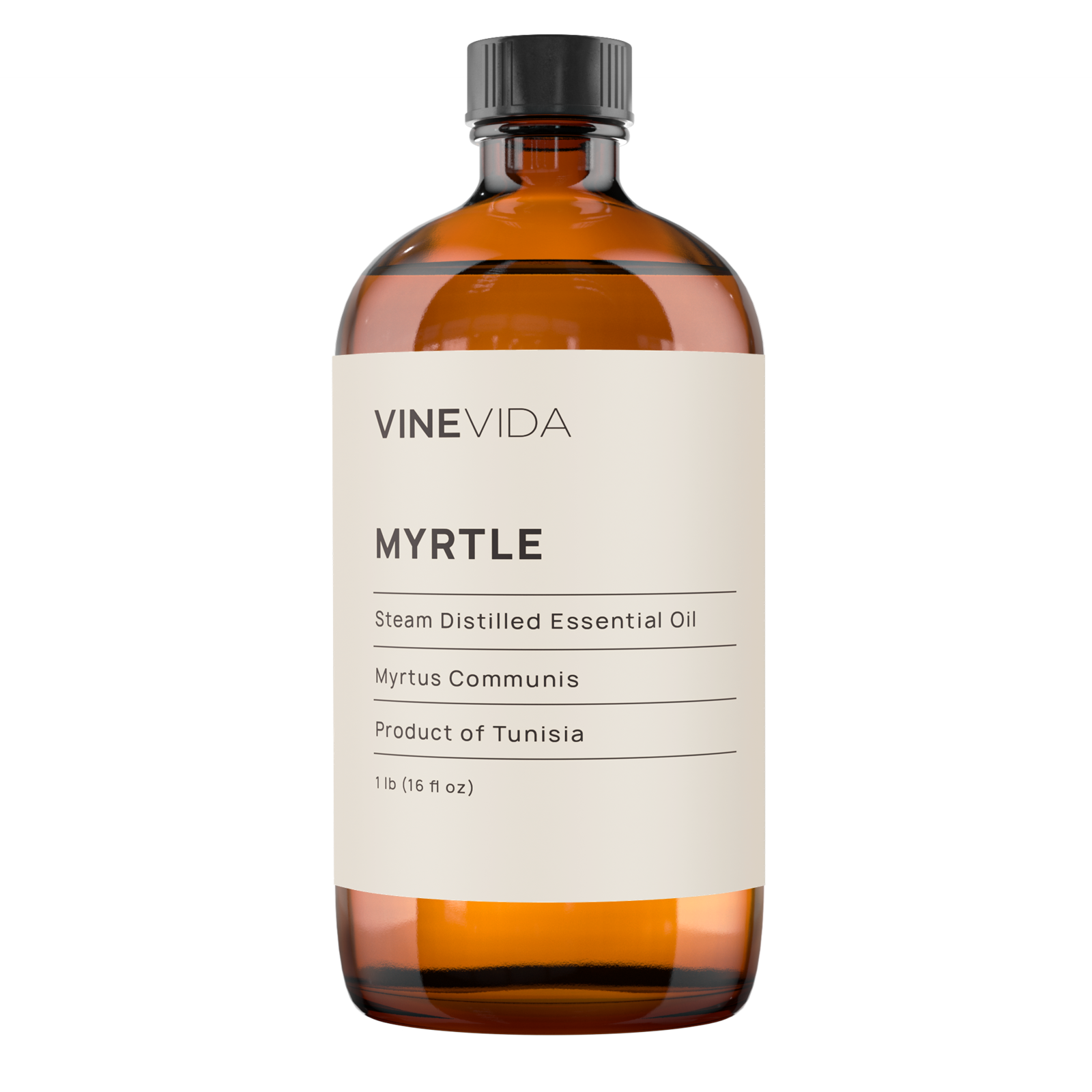
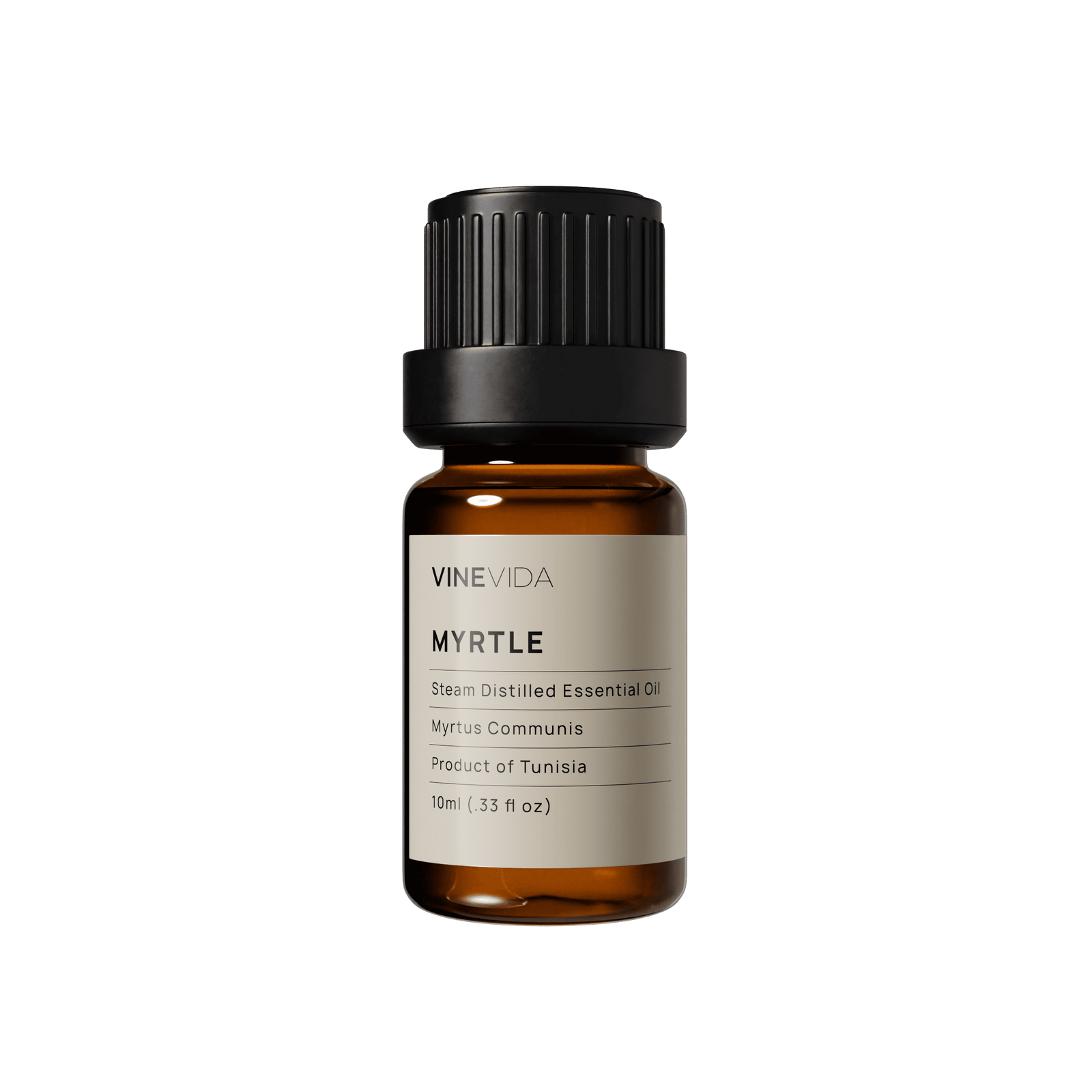
Scientific Name: Myrtus Communis
Origin: Tunisia
Plant Part: Leaves
Scent: Fresh, bitter, herbaceous
Color: Clear to pale green
Consistency: Thin
Perfumery Note: Middle to top
Initial Aroma Strength: Moderate
Extraction Method: Steam Distillation
Suitable Blending Oils: Clinical fragrances like Eucalyptus and Tea Tree, herbs like Lavender and Chamomile, spices like Cinnamon and Clove.
Breaking Down the Myrtle Essential Oil’s Key Chemical Components
Common Myrtle (Myrtus Communis) is the only European member of the Myrtaceae family that includes tea tree, manuka, and kanuka in other countries.
Perhaps then the chemistry of Myrtle Essential Oil will come as no surprise.
-
- Alpha Pinene: 52.43%
- Limonene: 17.3%
- 1,8 Cineole: 10.69%
It is native to the Mediterranean area and has adapted well to the poor, dry soils found there. It is a small evergreen tree with aromatic, pointed, ovate leaves. Throughout the summer, the shrub gets covered in dainty five-petalled flowers which have dominant yellow stamens that bees adore. The leaves smell wonderful but have quite a bitter taste, which is well beloved in Middle Eastern cooking. Leaves are often placed into ovens where bread is baking, for example. Historical Uses of Myrtle Essential Oil Poor old Myrtle Essential Oil, J K Rowling did her no favors at all. Far from being “Moaning Myrtle”, Myrtle Essential Oil is loving, balanced, and incredibly powerful at taking care of our bodies.
When you look at the chemistry of Myrtle Essential Oil, it probably becomes more obvious why it was one of the most important plants of the ancient world. Native to the Mediterranean, and enjoying fragrance and evergreen leaves, it became an important ingredient for medicine and sacred rituals.
The first historical mention of myrtle appears in a recipe of plants that were used to please the Sumerian gods, which dates to around 2100 BCE. Records show that stalks and leaves were burned to accompany incantations and sacrifices. Eventually, myrtle would become a symbol and beloved plant to invoke their goddess, Ishtar, and as such, a mantle of the Divine Feminine.
Myrtle Essential Oil in The Ancient World?
Myrtle Essential Oil would not have been used in the ancient world, since we do not think distillation was invented until around the 12th century. Their medicines tended to be decoctions of the wood leaves and berries in wine, or the powder pulverized and made into a paste. So why are we interested in the history of how Myrtle was used?
Today, we are only just beginning to re-understand how the mind and body are related and thus how spiritual uses for plants can often influence the body too. The ancients always saw medicine this way, but sadly, in most cases, the wisdom is lost. In Myrtle’s case, though, there is a great deal of evidence left behind. Looking at the myths and legends of the past may help us understand more ways we can use Myrtle Essential Oil.
Since there is much to be learned from the spiritual significance of Myrtle Essential Oil, this is a long section. So, I’ll quickly outline the main uses for Myrtle Essential Oil, then you can look for the deeper ideas in the text.
Myrtle Essential Oil Uses and Benefits
-
- Astringent - wonderful for skin cleansing, especially for greasy skin and acne
- Antibiotic - Great if you cut yourself, but also for coughs and colds
- Respiratory Infections
- Genito-urinary infections
- Bleeding, especially bleeding hemorrhoids
- Antifungal - great for fungal nail infections
- Uplifting and soothing
- Cosseting and comforting
History of Myrtle in Ancient Greece
The ancient Greeks were fascinated by myrtle. Pausanius reports how it was sacred to both Aphrodite and Demeter. This may be because bees adore myrtle flowers, and both of these goddesses were worshiped as bees and had priestesses who were called Melissae, bees. Myrtle is also sacred to Athena.
Myrtle trees were planted in all of Aphrodite’s sanctuaries, and it is said that the name of the plant originates from the Greek word ‘myrtos’, which means “herb of love.” It is believed that they chose the word because it shared the same Semitic root as ‘myrrh’. (There is a myth that Aphrodite’s beloved Adonis was born of a myrrh tree.)
Both myrrh and Myrtle Essential Oils are aromatic and used for purification and cleansing in rituals.
Myrtle Essential Oil and The Divine Feminine
A dream interpreter, Artemidorus, described how "a myrtle garland signifies the same as an olive garland, except that it is especially auspicious for farmers because of Demeter and for women because of Aphrodite.” The olive branch is known to represent peace, victory, and prosperity.
Myrtle appears in many of Aphrodite’s myths. Some tellings of her origin story tell how, when she was born, she rose from the sea holding a myrtle leaf. Another tells how one day she visited the island of Cythera, but when she arrived naked, she was confronted by a herd of lasciviousatyrsys
So “to myrtle” means to grind the powder, but also to treat someone with it. It is usually done by groups of women who are close to your family.
“Did your mother myrtle you?” means: “Did she cosset you and invest time in your education?”
I love the scolding: “She got tired of your myrtling.” This means she spent ages making that powder for you because she cared for you, and now, how do you repay that? You have a debt to be paid till the end of her days.
This is a very telling tradition since Myrtle Essential Oil does make you feel like someone is really taking care of you. It is recommended for people who have gone through some kind of trauma and for children who are very upset.
Other Emotional Uses for Myrtle Essential Oil
Myrtle Essential Oil is wonderful for self-destructive tendencies and feelings of hopelessness.
Is Myrtle Essential Oil Safe To Use?
According to Tisserand and Young, the maximum dilution of Myrtle Essential Oil is 1.9%.
If you are using it in children, use it in dilutions of not more than 0.5%.
Not suitable for use in the first 16 weeks of pregnancy.
DIY Myrtle Essential Oil Blends
Myrtle Essential Oil Blend for Heavy Periods
-
- 50 ml Rosehip Carrier Oil (Rosa Rugosa)
- 25 drops Myrtle Essential Oil (Myrtus Communis)
- 10 drops Jasmine Absolute Oil (Jasminum Grandiflorum)
- 30 drops Clary Sage Essential Oil (Salvia sclarea)
Method of use: Massage over the pelvis twice a day for three months.
Safety: Moot point, but not suitable for use during pregnancy.
Myrtle Essential Oil Blend for Digestion
-
- 5 ml Grapeseed Carrier Oil (Vitus Vinifera)
- 3 drops Myrtle Essential Oil (Myrtus Communis)
- 3 drops Cardamom Essential Oil (Elettaria Cardamom)
- 3 drops Carrot Seed Essential Oil (Daucus carota)
Method of Use: Massage on the abdomen three times a day until symptoms subside.
Safety: Not suitable for use in the first 16 weeks of pregnancy.
Diffuser Myrtle Essential Oil Blend for Emotional Distress
-
- 1 drop Myrtle Essential Oil (Myrtus Communis)
- 1 drop Roman Chamomile Essential Oil (Anthemis Nobilis)
- 1 drop Spearmint Essential Oil (Mentha Spicata)
Why Choose VINEVIDA
At VINEVIDA, we love botanicals and the planet they come from. We believe in stocking the best at affordable prices and supplying to the discerning, which is why we are also members of both the Alliance of International Aromatherapists and the National Association of Holistic Aromatherapy. In recognition of our excellent standard of product, we are proud to hold a 2021 Certificate of Registration as a Cosmetic Products Establishment with the U.S. Dnd Food aandHuman Services..
Our joy at seeing people make beautiful things means we stock from the smallest amounts to the largest. Our bulk Essential Oils’ prices begin with our smallest Essential Oil of 10ml to our largest of 396lb, meaning any manufacturing company can afford to stock as many or as few oils as their business can accommodate without running the risk of spoilage of some of nature’s most precious commodities. So why not see if you can save money by buying your Myrtle Essential Oil in bulk? Remember how stable it has proven to be, so as long as you store it carefully, it should last and last.
Don’t forget that we like to look after our customers with reasonable prices and excellent customer serviceand reward the loyal ones with money-off discounts over the year.
Conclusion
So, why not check out if you qualify for our loyalty scheme and start saving today with an environmentally friendly choice of oil for skin, hair, massage oils, and soapmaking? Add VINEVIDA Myrtle Essential Oil to your cart today.
 Certificate of Analysis


You may also like
Recently viewed