I’m coming to this article from a rather unique perspective. Not only as a clinical aromatherapist with nearly 35 years of experience, but also as a wife and mother. My husband and son are both facing hair growth challenges, so I am personally about to embark on a therapeutic journey to think about how to mix essential oils with carrier oils for hair growth, and I thought you might find it interesting to accompany me.
My Interests in Hair Growth Challenges
My husband, The Strong Silent One, as I call him, was tragically completely bald by the time he was 19. However, he remained otherwise very sporting, the kind of beard to make any decent Viking proud, until he developed mouth cancer two years ago and lost his upper jaw. He subsequently had reconstructive surgery, but radiotherapy has burned all the hair follicles on his face. He no longer has hair on the affected side, only on his good side, and I have to nag him to shave to prevent terrifying checkout operators, thinking they are serving a very wild, lopsided man!
My youngest son seems to have inherited his hair genes. Despite having cultivated the most fantastic blonde mane of a lion, these days I can see more and more pink scalp shining through. (Poor lad. He’s only 16.)
So we have three different aspects to think about.
-
- The Silent One has a bald head. Can we do anything about that? I don’t think so. Too many years have passed.
- The Silent One’s beard hair: Honestly, you have never seen anything like the mess radiotherapy caused inside and out of his mouth, so he needed time for the inflammation to just recede. We do know the follicles are still active because 18 months later, there is some “bum-fluff” (as he calls it) coming through, as he calls it - Like baby hair - so we want to really give some TLC to the skin to try to restore it, then to try and draw the hair growth out.
- Junior Lion is far from bald. His mane is long, blonde, and wild. It can err on the side of greasy, because of his age and general idleness with shampoo. Nevertheless, the front of his hair is losing structure. What is growing is like baby hair and is ever more sparse. So for him, we need to think about protecting what we have and trying to wake up follicles that might be dormant.
With all of that said…let’s crack on and think about the different oils we have at our disposal.
Carrier Oils vs Essential Oils: What’s The Difference?
Excellent question. I’m glad you asked.
First, let’s clarify that the terms “Fixed Oils,” “Vegetable Oil,” and “Carrier Oil” all mean the same thing, in this context.
A carrier oil is a fixed oil that is used to dilute essential oils safely. We say carrier…because it carries!
Essential oils evaporate, which is why they smell so nice. This is because they are composed of really tiny molecules that can evaporate. Fixed oils are more stable, and therefore, they tend to have little or no smell in comparison. Fixed oils tend to be cold-pressed from seeds and from various kinds of vegetables.
Where essential oils tend to be more hormonal and work beneath the surface, carrier oils tend to be better at filling spaces between skin cells, hair cells, and actually penetrating the hair itself. This is not an exact science, but it will help to orient you with it.
Long story short, essential oils will do some stuff, carrier oils can do some stuff. Essential oils and carrier oils together…more than double the stuff. This is called a synergistic effect.
Next: Let’s think about hair loss.
Hair Loss
Pattern Baldness And Alopecia
This is mainly down to a hormone known as DHT (dihydrotestosterone), which is converted from testosterone and causes hair loss by binding to hair follicles in the scalp. DHT shrinks hair follicles, weakening them until they eventually stop producing hair. This process, sometimes called miniaturization, leads to pattern baldness (receding hairline and crown loss).
How DHT Causes Hair Loss
-
- Follicular Miniaturization: DHT attaches to scalp receptors, causing follicles to shrink and produce thinner, weaker hair, notes the Harley Street Hair Transplant Clinics.
- Shortened Growth Cycle: DHT shortens the anagen (growth) phase and prolongs the telogen (resting/shedding) phase, leading to shorter hair life, according to the Online Doctor by Well Pharmacy.
- Genetic Sensitivity: People with genetic predisposition have more sensitive receptors, making them prone to androgenetic alopecia, according to the National Institutes of Health (NIH).
Key Treatments & Blockers
-
- Finasteride (Propecia): An oral medication that inhibits 5-alpha-reductase, the enzyme that converts testosterone into DHT.
- Minoxidil (Rogaine): Topical treatment that promotes hair growth directly, often paired with blockers.
- Ketoconazole Shampoo: Medicated shampoo that can reduce scalp DHT, say studies, notes the Harley Street Hair Transplant Clinics.
- Saw Palmetto: A natural supplement often used to reduce DHT buildup in the scalp. We’ll talk about this in the article, as it has many forms. As well as capsules, this can be used as a carrier oil, and there is also an essential oil commercially available.
The Best Carrier Oils for Hair Growth
Pumpkin Seed Oil (Cucurbita pepo)
This is currently the heavyweight champion of fixed oils for hair growth, specifically for androgenetic alopecia (pattern thinning).
-
- The Science: A famous double-blind, placebo-controlled study found that men taking 400 mg of pumpkin seed oil daily saw a 40% increase in hair count after 24 weeks. (Cho, 2014)
- The Mechanism: It contains phytosterols (like beta-sitosterol) that act as natural 5-alpha reductase inhibitors—essentially blocking DHT, the hormone responsible for shrinking follicles.
It should be noted that most research focuses on oral supplementation, though some emerging studies suggest topical application might also inhibit DHT at the scalp level.
Coconut Oil (Cocos nucifera)
Interestingly, coconut oil doesn't "grow" hair in the sense of waking up dormant follicles, but it’s the only one with "legal" proof of saving the hair you already have.
-
- The Science: Research in the Journal of Cosmetic Science showed that coconut oil is the only oil capable of significantly reducing protein loss in both damaged and undamaged hair. (Rele, 2003)
- The Mechanism: Because of its low molecular weight and straight linear chain (lauric acid), coconut can actually penetrate inside the hair shaft, where other oils like sunflower or mineral oil just sit on top. By preventing protein loss, it stops breakage, which makes hair appear thicker and allows it to reach longer terminal lengths.
In the study done with Mineral oils and sunflower oils, Coconut oil was the only one that significantly reduced protein loss for both undamaged and damaged hair.
This one IS topical use, and we’ll address that in the applications part.
NOTE: This is a nut oil, so it would not be suitable for anyone with a nut allergy.
Saw Palmetto Oil (Serenoa repens)
You may have seen Saw Palmetto growing along the coasts of Florida. A small palm, it grows dark purple fruits, and it is the pulp from these fruits that creates the medicine.
In the world of clinical aromatherapy, we often talk about "feeding" the hair, but Saw Palmetto is more about defending it. Its claim to fame is its high concentration of fatty acids and phytosterols, which have a very specific job: inhibiting 5-alpha reductase.
-
- The Science: This is the enzyme responsible for converting testosterone into DHT (dihydrotestosterone). DHT is the "follicle-shrinker" that causes hair to thin out and eventually stop growing—the primary culprit in androgenetic alopecia.
- The Research: Clinical trials have shown that the topical application of Saw Palmetto can increase hair density by nearly 35% in users struggling with hormonal thinning. It essentially "mops up" the DHT at the scalp level before it can do its damage.
- The "Secret Healer" Touch: Because it's a thick, potent oil, it’s best used in a blend. Think of it as the "active ingredient" in your scalp tonic rather than a standalone carrier.
Argan Oil (Argania Spinosa)

Lacks robust clinical trials proving it stimulates new growth, but it is scientifically proven to protect hair from oxidative damage (UV rays) and reduce damage from hair dyes. It’s more of a "bodyguard" than a "stimulator."
Castor Oil (Ricinus Communis)

Despite being the internet's favorite for lashes and brows, almost zero human clinical data proves it regrows hair. Its reputation likely comes from its high ricinoleic acid content, which, in theory (and computer models), inhibits Prostaglandin D2, a known hair-growth inhibitor. In practice, it's mostly a fantastic humectant that creates a "glossy" optical illusion of thickness.
Carrier Oils to Encourage Hair Growth Radiotherapy
Tamanu Oil (Calophyllum inophyllum)

For long-term recovery (relevant because the Silent One is eighteen months post-radiotherapy), Tamanu oil is perhaps the most scientifically "appropriate" intervention for damaged skin.
Often referred to as "Green Gold" in clinical aromatherapy, its power lies in cicatrization - that is, the ability to promote the formation of healthy new tissue. (Hughes, 2020)
Research by Ansel et al. (2016) confirms that Tamanu significantly increases the production of collagen and glycosaminoglycans (GAGs), essentially signaling the skin to rebuild its internal structure rather than just moisturizing the surface. (Ansel, 2016)
Beyond its skills with skin repair, Tamanu acts as a sophisticated "reprogrammer" for the skin's environment. While radiation often triggers TGF-β1, the signaling molecule responsible for the hardening of tissue known as fibrosis, recent molecular docking studies suggest that Tamanu’s unique constituents, like calophyllolide, can help inhibit this pathway. (Krishnappa, 2024)
This prevents the scalp or beard area from becoming a "fibrous desert" where hair cannot thrive. Most excitingly, a 2020 study in the Polynesian Cosmetopoeia found that Tamanu directly stimulates the Dermal Papilla Cells—the very "command center" of the hair follicle. By upregulating growth genes and downregulating hair-inhibiting factors, Tamanu ensures the "soil" isn't just soft, but actively encourages new growth to return. (Hughes, 2020)
Black Seed Oil (Nigella sativa)
For skin that has braved radiotherapy, the recovery needs to go deeper than the surface. Radiation often wipes out vital antioxidant enzymes like superoxide dismutase, leaving the tissue vulnerable to chronic oxidative stress and leaving a kind of cellular exhaustion behind it.
Black Seed oil contains high concentrations of thymoquinone, a potent compound that acts like a regenerative powerhouse. Research, including a 2014 study (done on rats), highlights its "radioprotective" properties—essentially acting as a shield for the skin's internal defense systems. Black Seed oil helps repair the "biological infrastructure" of the skin, providing protection and stability for hair follicles to flourish once again. (Cikman, 2014)
Sea Buckthorn Berry Oil (Hippophae ramnoides)
Often called a botanical "miracle" for post-radiation recovery, this vibrant extract is drawn from bright orange berries, growing in the very harshest conditions. If you saw them growing on a dune, you’d beware because they are surrounded by vicious thorns. This is a botanical that knows how to protect.
Sea buckthorn is one of nature’s richest sources of Omega-7 (palmitoleic acid). While modern science usually focuses on its role in mucosal repair, research (Shi, 2017) confirms its profound ability to accelerate dermal regeneration, effectively "re-fleshing" skin that has been thinned or compromised by radiation damage.
Sea Buckthorn can be used as a carrier oil or a CO2. While it has no scent, it is very, very vivid orange, and it does have the capability to stain the skin. Therefore, even though it would be safe enough to use more, we would use a maximum dilution of 5%.
Rosehip Oil (Rosa rugosa (Syn. Rosa rubiginosa) )

If the skin feels tight or "tough" following radiotherapy, it may be that the follicles have become trapped closed by a process called subclinical fibrosis, which means that the skin's collagen becomes dense and inflexible.
Think of Rosehip as the "soil tiller" for this hardened terrain.
Famous for its regenerative properties, Rosehip oil is rich in essential fatty acids (linoleic and linolenic) and trace amounts of natural trans-retinoic acid. Unlike aggressive synthetic retinoids, this botanical version works gently to encourage cell turnover and support the remodeling of scarred or damaged tissue. By helping to reorganize the collagen fibers and restoring elasticity to the dermis, Rosehip creates a softer, more pliable environment that allows dormant hair to finally break through the surface. Pareja & Kehl (1988)
Jojoba Oil (Simmondsia chinensis)

Technically, not an oil, despite its name, jojoba is a wax ester. This is relevant because its constituency is very similar to that of sebum and has the capacity to sink deep into the tissues.
Weighing Which Carrier Oils To Choose For Hair Growth
-
- To reduce the hormone attacking the hair: Pumpkin & Saw Palmetto
- To protect the existing hair against water and protein loss: Coconut
- To protect the hair against sun and heat damage: Argan and Castor Oil
- To make hair look thicker and glossier: Argan and Castor
- For deep tissue repair: Tamanu, Seabuckthorn, and Rosehip
How to Use Carrier Oils for Hair Growth
Before we get into the essential oils, let’s talk a little bit about how we’re going to use the fixed oils.
If we are talking about pattern baldness and alopecia, don’t be misled by the posts that suggest mixing your oils into shampoos.
The nature of the medicine here is that it needs time to process, and we don’t want to wash them out before the oils have had time to work.
Therefore, we have two options available to us. We could add them to leave-in conditioners or use the oils as massage oils that we can leave on. If you read essential oils for hair growth, the Pros and Cons, you will see that massage can be the magic that sparks the healing here, so let’s also consider that.
So, I am going to choose a leave-in massage oil because that will give us much more scope to add in carriers, get them into the hair and the skin, and then essential oils into the skin with massage too. Pertinently, I want to have mainly coconut as my tool, so that it can penetrate the hairs, no matter how small and delicate they are, to give them strength and structure, then everything else is like a backup to this.
Ideally, we’re going to make a product that we can leave on for 30 mins before a shower, then wash out all the residue.
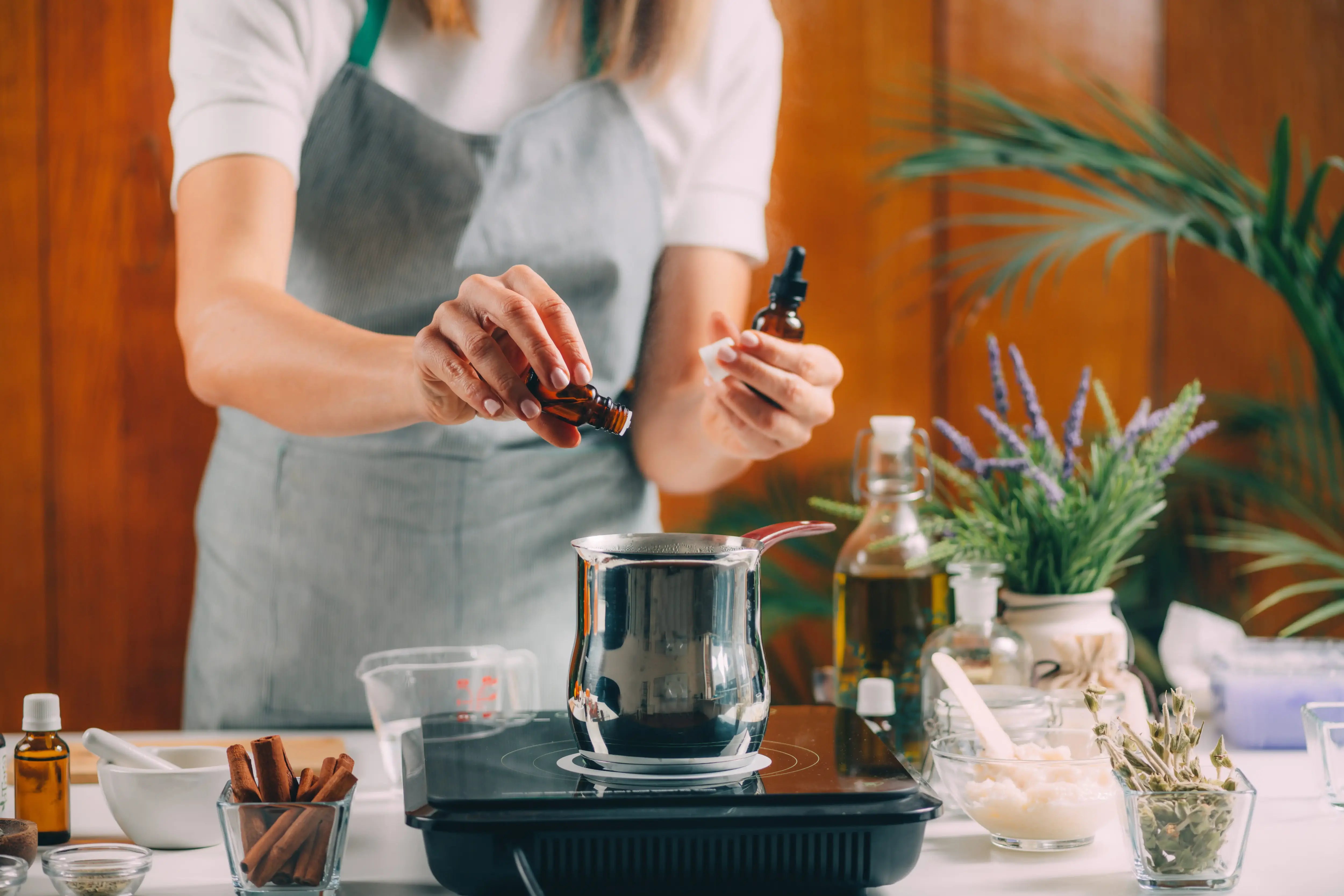
How to Mix Essential Oils and Carrier Oils for Hair Growth
The oils we are going to focus on are rosemary, lavender, cedarwood, saw palmetto, and spikenard. Explanations of why in the 5 Best Essential Oils for Hair Growth.
First, blend your carrier oils. Choose the one most suited to your requirements, or blend together a few.
For pattern baldness, I’m going to blend coconut, saw palmetto, and pumpkin to block the DHA and to try to improve the structure of the hair shafts.
This is where a bit of knowledge is helpful because pumpkin seed is really quite a dirty-looking oil, and coconut is much nicer. So let’s split that into roughly thirds, with most of the volume on coconut. Remember that your coconut will be solid at room temperature, so you are going to want to gently heat the blend to blend it.
Recipe To Encourage Hair Growth in Thinning Hair
-
- 10ml Pumpkin Seed carrier oil (Cucurbita pepo)
- 20ml Saw Palmetto CARRIER oil (Serenoa repens)
- 60ml Virgin Unrefined Coconut oil (Cocos nucifera)
- 20 drops Cedarwood Virginian essential oil (Juniperus virginiana)
- 10 drops Rosemary Essential Oil (Rosmarinus officinalis) *See safety note below
- 10 drops Lavender Essential Oil (Lavandula angustifolia)
- 10 drops Saw Palmetto ESSENTIAL oil (Serenoa repens)
Method of Preparation:
-
- Gently heat the coconut just enough to make it liquid. Add your Pumpkin and Saw Palmetto oils, mix well, and allow the mix to cool a little.
- Essential oils spoil when heated, so you want to add them just as the oil cools, before it goes solid.
- Add to a sterilized jar and label clearly with ingredients and data.
Method of use:
-
- Add a small amount to a little bowl and place the bowl into warm water to warm the oil a little.
- Begin by gently massaging the treatment into the scalp, then draw down all of the strands of hair.
- Wrap in a warm towel to increase penetration and to protect the furniture while you watch TV!
- Shampoo, rinse, and shampoo again to remove residue.
Safety:
-
- Not suitable for use in the first 16 weeks of pregnancy.
- Rosemary can also be problematic for people who suffer from delusional conditions such as psychosis or schizophrenia.
- People living with epilepsy should also take care with rosemary.
Recipe to Encourage Hair Growth After Cancer Treatment
It struck me that radiotherapy is not the only reason you would lose hair after cancer treatment. Of course, it also happens after chemotherapy. Similarly, this recipe is for his face, but I suspect he will use it on his arm that is scarred after a skin graft, to try to make the hair grow there too.
It goes without saying to treat the skin gently.
All the oils I have included in this blend are heavy hitters, and if we are not careful, the skin will feel like it is eating Christmas dinner every day, so I have cut it with some grapeseed to make it go a little further. This will also help to dilute the color of the Black Seed Oil, which might otherwise be a problem.
The oils are inspired by a clinical trial (Hay, 1998) into using essential oils for hair growth.
-
- 50 ml Jojoba Carrier oil (Simmondsia Chinensis)
- 20ml Grapeseed Carrier oil (Vitis Vinifera)
- 5ml Tamanu Carrier oil (Calophyllum Inophyllum)
- 5ml Rosehip Carrier oil (Rosa Canina)
- 5ml Sea Buckthorn Carrier oil (Hippophae rhamnoides)
- 5ml Black Seed Oil Carrier oil (Nigella sativa)
- 20 drops Cedarwood virginian essential oil (Juniperus Virginiana)
- 10 drops Rosemary essential oil (Rosmarinus Officinalis)
- 10 drops Lavender essential oil (Lavandula Angustifolia)
- 10 drops Thyme essential oil (Thymus Vulgaris)
Method of Preparation:
-
- All oils are liquid at room temperature, so simply measure them into a sterilized container and label clearly.
Method of Use:
-
- Massage into the affected part daily.
- You could, in fact, use this up to three times a day. No need to wash off.
Safety:
-
- Not suitable for use in the first 16 weeks of pregnancy.
- Rosemary can also be problematic for people who live with delusory conditions such as psychosis or schizophrenia.
- It can also be difficult for people living with epilepsy.
Conclusion
I have to say that, as someone who has always had way too much hair, it has been quite eye-opening for me to look into just how much research there is into botanical products for hair loss. These are really beautiful recipes, and I hope you have enjoyed thinking about how to mix essential oils with carrier oils for hair growth with me. And don’t forget to wave if you do happen to see me out and about. I’ll be the redhead walking down the road with two bears!