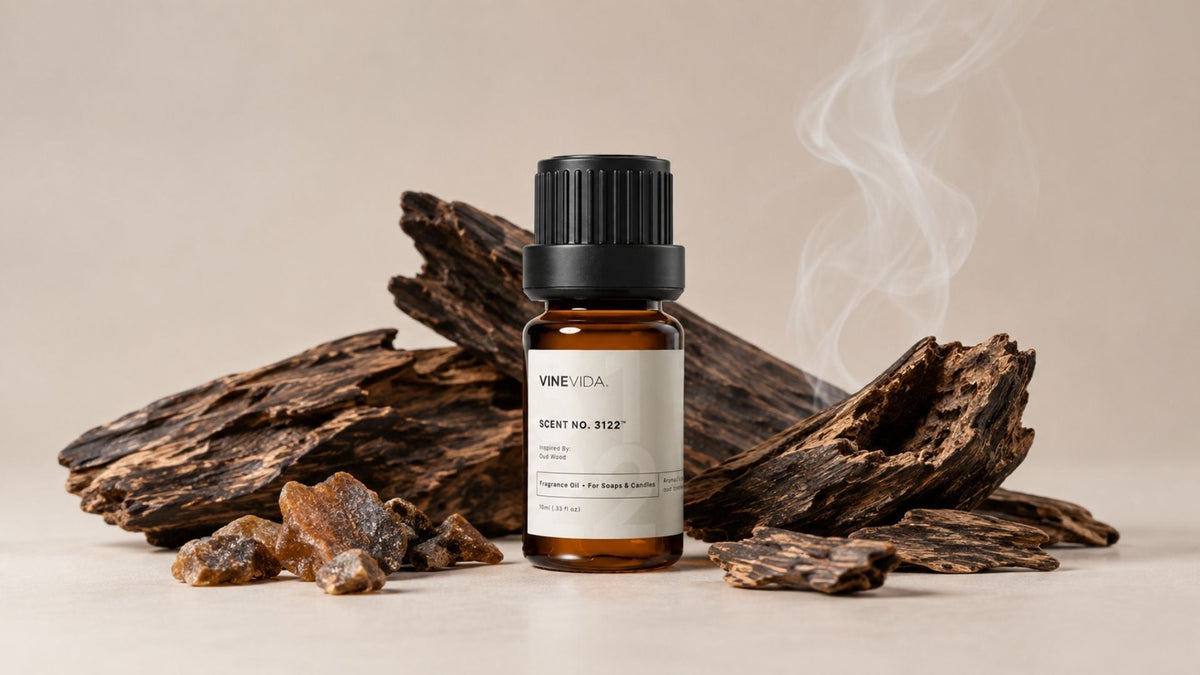
Oud is the fragrance material and scent associated with agarwood, one of the most distinctive and highly valued materials in perfumery. It is often described as dark, woody, smoky, resinous, and luxurious, but natural oud can also smell sweet, earthy, leathery, balsamic, fruity, or animalic.
Not every fragrance labeled oud contains natural agarwood oil. Modern perfumes may use natural oud, synthetic or reconstructed oud accords, or combinations of aroma materials designed to recreate parts of its scent.
Natural oud can also vary considerably depending on the source material, resin development, age, and extraction. This guide explains where oud comes from, what it smells like, why it is so prized, how natural and synthetic oud differ, and the role oud plays in fragrance.
What Is Oud Fragrance?
Oud is the fragrance material associated with agarwood, the dark, resin-rich aromatic wood that develops in certain Aquilaria trees after injury or related biological stress.
As the tree responds to affected tissue, aromatic resin can accumulate in the wood over time, making it darker and more fragrant. This resin-rich wood is known as agarwood.
Agarwood can be distilled or otherwise processed to obtain aromatic oud oil. In finished fragrances, however, oud may refer to:
-
Natural agarwood-derived oud
-
A synthetic or reconstructed oud accord
-
A fragrance composition designed to evoke the scent of agarwood
This is why two fragrances labeled oud can smell very different from one another.
What Does Oud Smell Like?

Oud typically smells deep, woody, resinous, earthy, and warm, often with smoky, balsamic, or leathery facets. Some varieties can also smell slightly sweet or fruity, while certain natural ouds may have a distinctly animalic character.
There is no single universal oud smell. Depending on the material, oud can range from sweet, smooth, and fruity to earthy, smoky, leathery, and animalic.
Natural oud varies with the agarwood itself and how it is processed. One material may smell polished and softly sweet, while another feels much darker, smokier, earthier, or more intense. Fragrance houses describe the same range in different ways: Creed highlights warm, earthy, intense, sensual, and sometimes animalic qualities, while Phlur emphasizes dark woody, smoky, balsamic, and slightly sweet facets.
Where Does Oud Come From?
Natural oud comes from agarwood produced by certain Aquilaria trees native to parts of South and Southeast Asia. Countries associated with agarwood production include:
-
Bangladesh
-
India
-
Thailand
-
Indonesia
-
Cambodia
-
Malaysia
-
Vietnam
Only some Aquilaria trees develop enough resin-rich heartwood to become valuable agarwood, which is one reason natural oud is relatively scarce.
Geographic origin can influence the character of the material, but it does not determine one fixed oud style. Differences in species, resin development, and processing can all affect how the resulting agarwood or oud oil smells.
How Does Agarwood Form?
 Agarwood forms as part of the tree’s response to injury and biological stress rather than as a normal feature of healthy wood.
In simplified terms, the process looks like this:
-
The Aquilaria tree is wounded or otherwise stressed.
-
Biological activity can develop around the affected area, including fungal association.
-
The tree responds by producing defensive resin.
-
That resin accumulates in the wood over time.
-
The affected heartwood darkens and becomes more aromatic.
-
The resulting resin-rich wood is known as agarwood.
Research describes agarwood formation as a defense response associated with wounding and microbial activity, including fungal infection. Fungi can contribute to the process, but they are not the only factor involved. The tree’s own response, time, and surrounding conditions also influence how agarwood develops.
Oud, Agarwood & Oudh: Are They the Same?
The terms are closely related, but their meaning can vary slightly by culture, region, and market.
Agarwood
Agarwood is the resin-rich aromatic wood itself.
Oud or Oudh
Oud and oudh commonly refer to the fragrant material, oil, or scent associated with agarwood. In perfumery, oud can also describe an accord created to evoke the character of agarwood.
Agar
Agar is another regional term sometimes used in connection with agarwood.
These terms often overlap in everyday fragrance use, but they usually refer to closely related aspects of the same aromatic material.
How Is Oud Oil Made?
Oud oil is made by processing and distilling resin-rich agarwood. The exact method varies, but the process commonly includes:
-
Selecting resin-rich agarwood
-
Chipping, crushing, or grinding the wood
-
Soaking or preparing it in processes that use this step
-
Extracting the aromatic oil through hydro-distillation or steam distillation
-
Collecting and separating the resulting oil
Soaking is used in some traditional production methods, but preparation and distillation practices are not identical from one producer to another.
The finished aroma also depends on more than the extraction method. The quality and resin content of the wood, preparation, distillation conditions, and aging or storage of the oil can all influence how a natural oud oil smells.
Why Is Oud So Expensive?
Natural oud is expensive because high-quality resin-rich agarwood is rare, takes time to develop, requires careful harvesting and processing, and remains in high demand across traditional fragrance markets and luxury perfumery.
Several factors contribute to its value:
-
Not every tree develops valuable agarwood. Only some Aquilaria trees form the resin-rich heartwood prized for oud.
-
Resin development takes time. Aromatic resin builds gradually within affected wood rather than forming all at once.
-
High-quality agarwood is scarce. Even when agarwood forms, resin concentration and quality can vary considerably.
-
Harvesting and distillation require time and labor. Suitable wood must be selected, prepared, and processed before the aromatic oil can be collected.
-
Demand remains high. Agarwood has long been valued in incense and personal fragrance and is also widely used in niche and luxury perfumery.
Prices can vary widely depending on origin, grade, resin content, processing, authenticity, and market conditions. That is why dramatic price claims about “oud” are not very useful unless the quality and form of the material are clearly identified.
Natural Oud vs Synthetic Oud
The word oud on a fragrance label does not necessarily mean the fragrance contains natural agarwood oil. Modern perfumes may use natural oud, a synthetic or reconstructed oud accord, or a combination of both.
|
Natural oud |
Synthetic or reconstructed oud accord |
|
|
Origin |
Derived from resin-rich agarwood |
Built from aroma materials to create an oud-like effect |
|
Consistency |
Naturally variable |
Easier to reproduce consistently |
|
Scent character |
Can be highly complex, earthy, smoky, resinous, leathery, or animalic |
Can be designed to smell cleaner, smoother, sweeter, smokier, or less animalic |
|
Cost |
Generally much more expensive |
More practical for large-scale fragrance production |
|
Availability |
Limited by agarwood supply and quality |
Easier to produce at scale |
|
How it is used |
Provides the character of natural agarwood |
Recreates or emphasizes selected facets of oud |
Synthetic and reconstructed oud accords serve a different purpose from natural oud. They give perfumers more control over consistency, cost, and scent style, which is one reason they are widely used in modern fragrance.
A reconstructed oud can be made smoother, sweeter, smokier, or less animalic depending on the effect the perfumer wants to create.
Why Can Oud Smell So Different From One Fragrance to Another?
Oud can smell very different from one fragrance to another because both the raw material and the fragrance formula shape the final result.
Natural oud varies with factors such as geographic origin, Aquilaria species, resin development, and extraction. Synthetic or reconstructed oud accords can also be designed to emphasize particular facets, while supporting notes such as rose, leather, amber, woods, or fruit can shift the composition in a completely different direction.
That is why one oud fragrance may smell sweet and smooth, another dark and smoky, and another more floral, leathery, woody, amber-rich, or fruity.
Regional Oud Styles
Regional descriptions can be useful when comparing natural oud, but they are best treated as general tendencies rather than fixed scent rules.
Indian Oud
Indian oud is often associated with darker, denser, earthier, and more animalic profiles. Some examples can also feel leathery or especially intense, although natural variation remains significant.
Cambodian Oud
Cambodian oud is often described as rich and resinous, with some examples leaning smoother, slightly sweeter, or subtly fruity. Not every Cambodian oud will show those qualities to the same degree.
Southeast Asian Oud More Broadly
Across Southeast Asia, oud can range from smoky and woody to balsamic, earthy, sweet, or resinous.
Regional origin can offer a useful clue, but it does not determine one fixed scent profile. The individual material still matters more than the country name alone.
Is Oud a Woody Fragrance?
Yes. Oud sits broadly within the woody fragrance family, but it can smell much more complex than a straightforward wood note. Depending on the material and composition, it may also show resinous, smoky, leathery, animalic, sweet, or balsamic facets.
That is why oud can feel quite different from cedarwood, sandalwood, and vetiver, even though all four sit within the broader woody landscape. Those differences are easier to compare across Spicy & Woody Fragrance Oils, where darker woods, softer woods, vetiver, patchouli, and spicy profiles sit side by side.
Is Oud a Base Note?
Often, yes. Oud is commonly used in the base of a fragrance because its depth and persistence can remain noticeable well into the drydown.
It can support florals, spices, amber-style accords, and other woods, giving the composition more depth and structure. That said, oud is not limited to the base. Some fragrances make it noticeable much earlier, depending on how the formula is built.
What Scents Pair Well With Oud?
Oud works with a wide range of fragrance notes, and each pairing can bring out a different side of its character.
|
Pairing |
Typical effect |
|
Oud + Rose |
Rich, floral, woody, and luxurious |
|
Oud + Saffron |
Dry, warm, spicy, and luxurious |
|
Oud + Amber |
Warm, resinous, and enveloping |
|
Oud + Vanilla |
Softer, sweeter, and creamier |
|
Oud + Sandalwood |
Smooth, woody, and rich |
|
Oud + Patchouli |
Darker, earthier, and deeper |
|
Oud + Citrus |
Brighter, with more contrast |
|
Oud + Musk |
Softer, smoother, and more skin-like |
|
Oud + Leather |
Dark, dry, bold, and smoky |
Rose and oud are a particularly recognizable pairing because the floral softness of rose contrasts with oud’s deeper woody and resinous character. Other combinations shift oud in different directions, from the brightness of citrus to the warmth of amber or the darker effect of leather and patchouli.
Oud vs Sandalwood
Oud and sandalwood are both woody fragrance materials, but they create very different effects.
|
Oud |
Sandalwood |
|
Darker |
Softer |
|
Resinous |
Creamier |
|
Often smoky |
Smoother |
|
Can be animalic |
Warmer |
|
More intense |
More mellow |
Oud tends to feel deeper, darker, and more resinous, while sandalwood is usually softer, creamier, and smoother. Both sit within the woody fragrance family, but their overall character is quite different.
Oud vs Vetiver
Oud tends to feel resinous, woody, smoky, and sometimes leathery, while vetiver is usually drier, grassier, rootier, and more earthy.
Both can add depth to a fragrance, but they create very different effects. Vetiver often keeps a dry, root-like freshness, while oud feels denser and more resinous. If you want more context on that contrast, vetiver scent gives you the broader profile without interrupting the flow.
Oud vs Amber
Oud is associated with resin-rich agarwood and usually brings a woody, resinous, smoky, or leathery character. Amber, by contrast, is generally a constructed fragrance style built around warm, balsamic, resinous, and often vanilla-like notes.
The two are frequently combined because their depth and warmth work well together, but they are not the same thing. That distinction becomes clearer when you compare oud with a broader amber scent profile.
Oud vs Musk
Oud is usually darker, woodier, more resinous, and often smokier, while musk can feel clean, powdery, soft, skin-like, warm, or woody depending on the style.
When the two are combined, musk can soften oud’s sharper edges and make the drydown feel smoother. That contrast is easier to understand when you look at the broader range of musk scent profiles.
Oud vs Leather
Oud and leather can share dark, dry, smoky, and sometimes animalic qualities, which is why they can feel similar in some fragrances. The difference is that natural oud comes from agarwood, while leather in modern perfumery is generally created as an olfactory accord or fragrance style rather than coming from one single material.
Why Is Oud Associated With Luxury?
Oud is associated with luxury because natural agarwood is rare, valuable, and labor-intensive to produce. Its long history in incense and personal fragrance, together with its strong and distinctive scent, has also given it deep cultural significance in several fragrance traditions.
Modern niche and luxury perfumery has built on that reputation, often using oud to create rich, distinctive woody compositions. That does not mean every fragrance labeled oud is expensive or contains natural agarwood oil. Some use synthetic or reconstructed oud accords instead.
Oud in Middle Eastern Fragrance Culture
Oud has a long and prominent place in Middle Eastern fragrance traditions, where agarwood has been valued in both its wood and oil forms.
Agarwood chips may be burned as incense, while oud oil and oud-based perfumes are used for personal fragrance. Oud is also associated with hospitality, religious practice, and other cultural settings, reflecting traditions that long predate its popularity in modern niche perfumery.
The raw material itself comes primarily from South and Southeast Asia, which has created a long-standing connection between agarwood-producing regions and fragrance traditions in the Middle East.
Is Oud Only for Men's Fragrance?
No. Oud is used in men's, women's, and unisex fragrances, and the way it comes across depends heavily on the notes around it.
Rose can pull oud in a more floral direction, while leather can make it feel darker and drier. Vanilla often softens it with sweetness, and citrus can make the opening feel brighter and fresher. Those shifts have more influence on how an oud fragrance is perceived and marketed than oud itself.
Oud is not inherently masculine.
Is Oud Always Strong?
Not necessarily. Natural oud can be very powerful and persistent, but synthetic or reconstructed oud accords can be made softer, cleaner, or more transparent. How intense an oud fragrance feels also depends on the formula, the concentration, the supporting notes, and whether oud is used as a dominant feature or more subtly in the base.
The word oud in a fragrance name does not tell you exactly how strong the scent will be. Fragrance concentration and fragrance character are separate, so a softer oud composition can still be an eau de parfum, while a lighter concentration may feature oud more prominently.
Light Oud vs Dark Oud
Thinking in terms of lighter and darker oud styles can be more useful than simply asking whether a fragrance contains oud, especially if you are still figuring out which direction you prefer.
Lighter Oud Styles
Lighter oud fragrances often pair oud with bergamot, other citrus notes, florals, clean musk, or softer woods. These combinations can make the composition feel brighter, smoother, and easier to approach.
Darker Oud Styles
Darker styles are more likely to bring oud together with leather, smoke, patchouli, amber-style accords, resins, or spices. The result can feel deeper, richer, warmer, and more dramatic.
Neither direction is more authentically oud. They simply emphasize different sides of the material or accord
How to Know If You'll Like Oud
You may enjoy oud if you already gravitate toward woody, smoky, resinous, leather, amber-style, patchouli, or otherwise rich and unconventional fragrances.
If you are new to oud, smoother combinations with rose, vanilla, citrus, or sandalwood can be easier to approach than darker, more animalic styles. Softer synthetic or reconstructed oud accords can also give you a cleaner introduction to the scent.
If you already prefer deeper fragrances, oud paired with leather, smoke, patchouli, or amber-style accords may suit you better. The easiest way to judge is to compare those directions with scents you already enjoy rather than treating oud as one fixed style.
How to Recognize Oud in a Fragrance
Oud may not be obvious in the first few seconds of a fragrance. A better way to pick it out is to let the composition develop.
-
Do not judge only from the opening. Citrus, fruit, spices, or other brighter notes may appear first.
-
Let those opening notes settle. Oud may become easier to notice as the fragrance moves into its deeper stages.
-
Look for a dark woody or resinous foundation. Oud can feel denser and more resinous than many familiar woods.
-
Notice its character. It may come across as smoky, leathery, earthy, sweet, or animalic.
-
Compare it with sandalwood and vetiver. Sandalwood is usually smoother and creamier, while vetiver tends to feel drier, grassier, and rootier.
-
Keep synthetic oud in mind. Reconstructed oud accords can be cleaner, smoother, or more polished than some natural oud materials.
Smell can help you recognize an oud-style profile, but it cannot confirm the exact ingredients used in a fragrance.
Common Oud Misconceptions
Several ideas about oud become misleading when they are treated as universal rules:
-
“Oud is just another wood note.” Oud is woody, but it can also smell resinous, smoky, leathery, sweet, earthy, or animalic, giving it a much broader character than many familiar woods.
-
“Every oud perfume contains real oud.” Not necessarily. A fragrance may use natural oud, a synthetic or reconstructed oud accord, or a combination designed to evoke agarwood.
-
“Oud always smells animalic.” No. Some natural ouds have animalic facets, while others can be smoother, sweeter, fruitier, or more polished.
-
“Oud is only for men.” Oud appears in men's, women's, and unisex fragrances. The surrounding notes and overall composition have more influence on how it is perceived and marketed.
-
“Oud and amber are the same.” They are different. Oud is associated with agarwood, while amber in modern perfumery is generally a constructed warm, resinous, and often sweet fragrance style.
-
“Oud and agarwood are completely different.” The terms refer to closely related aspects of the same aromatic material. Agarwood is the resin-rich wood, while oud more often refers to its oil, scent, or fragrance character.
-
“An expensive oud perfume must contain a large amount of natural oud.” Price alone does not reveal the formula or how much natural agarwood-derived material is present.
-
“All natural oud smells the same.” Natural oud can vary considerably with origin, Aquilaria species, resin development, age, and extraction.
Conclusion
Oud is the fragrance material associated with resin-rich agarwood formed in certain Aquilaria trees, and its scent can range from deep, woody, and smoky to sweet, balsamic, earthy, leathery, or animalic. Natural oud is rare, highly variable, and expensive, which is why many modern fragrances use reconstructed or synthetic oud accords instead.
Understanding the difference between natural oud, synthetic oud, and oud-style accords makes fragrance descriptions easier to interpret and helps you choose the type of oud you are more likely to enjoy. Rose, saffron, amber-style accords, vanilla, musk, sandalwood, leather, and citrus can all bring out different sides of oud, while VINEVIDA’s fragrance oils offer a broader range of scent directions to explore.
Frequently Asked Questions
What is oud fragrance?
Oud fragrance is a woody fragrance style associated with agarwood, the resin-rich aromatic wood formed in certain Aquilaria trees. In perfume, oud may come from natural agarwood-derived material, a synthetic or reconstructed oud accord, or a combination of both.
What does oud smell like?
Oud often smells deep, woody, resinous, earthy, smoky, balsamic, leathery, and warm. Some natural ouds can also be sweet, fruity, or animalic, which is why there is no single oud scent that represents every fragrance.
Why is oud so expensive?
Natural oud is expensive because high-quality resin-rich agarwood is scarce, takes time to develop, and requires careful harvesting and processing. Not every Aquilaria tree produces valuable agarwood, and the quality of the material can vary considerably.
Does every oud perfume contain real oud?
No. Many modern oud fragrances use synthetic or reconstructed oud accords because natural agarwood-derived material is rare, costly, and variable. These accords can recreate selected woody, smoky, leathery, sweet, or resinous facets of oud.
Is oud a masculine or feminine scent?
Oud is not inherently masculine or feminine. It appears in men's, women's, and unisex fragrances, and the notes around it often shape how the finished scent is perceived and marketed.
What scents pair well with oud?
Oud pairs well with rose, saffron, amber-style accords, vanilla, sandalwood, patchouli, musk, citrus, and leather. These pairings can make oud feel more floral, spicy, warm, sweet, smooth, bright, or dark depending on the composition.