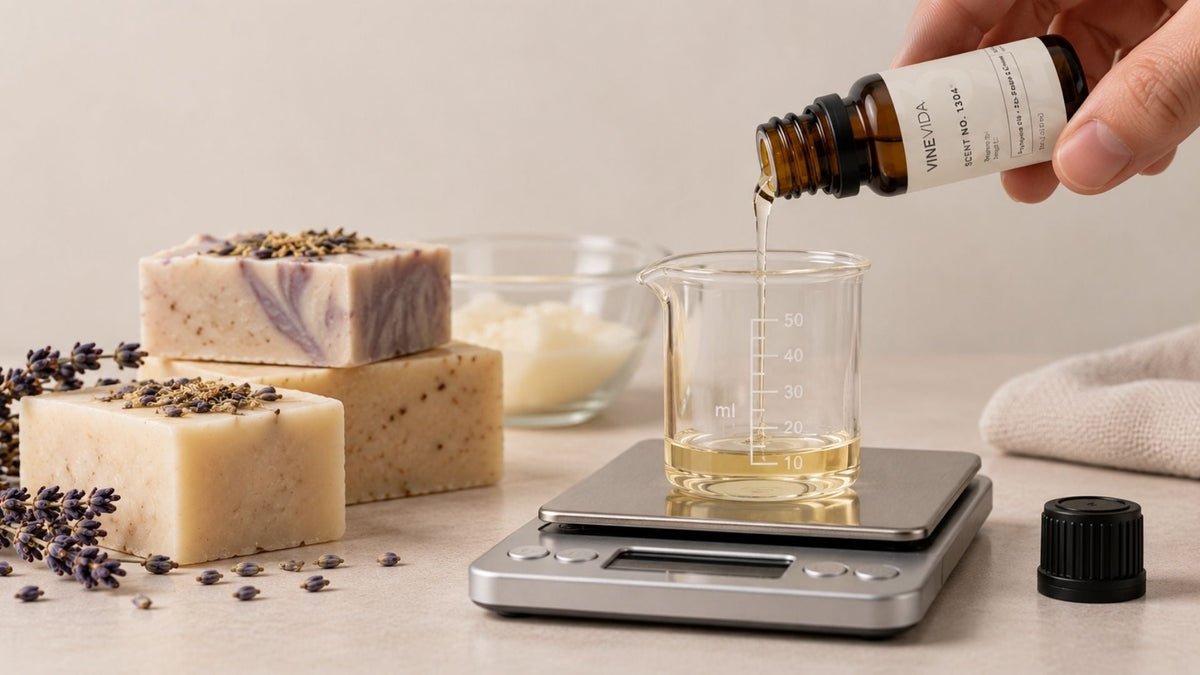
Soap fragrance amounts should be calculated from the correct batch weight rather than estimated. Using too much or too little can affect scent strength, cost, and soap performance, and a general usage rate should never override the applicable limit for the individual fragrance.
The phrase how much fragrance oil per pound of soap can be confusing because cold process soapmakers commonly calculate fragrance from the weight of the base oils in the recipe, not the total weight of freshly made or cured soap. Melt-and-pour, rebatch, and liquid soap are not necessarily calculated the same way and may use different typical fragrance amounts.
This guide explains Per Pound of Oils (PPO) calculations, fragrance percentages, soap-type differences, International Fragrance Association (IFRA) limits, and batch scaling so you can determine the appropriate fragrance amount for the soap you are making.
How Much Fragrance Oil Should You Use Per Pound of Soap?
For cold process soap, many soapmakers use roughly 0.7–1 oz of fragrance oil per pound of base oils (PPO) as a working range. Lovin Soap, for example, uses 0.7–1 oz PPO as its standard fragrance-oil range, while Bramble Berry lists 0.7 oz per pound as a general medium-strength reference for cold process soap.
These figures are starting points, not universal usage rates. The appropriate amount can vary with the specific fragrance, recipe, desired scent strength, supplier guidance, and the fragrance's applicable IFRA maximum.
Never use a generic PPO rate if it would exceed the fragrance oil's current IFRA maximum for the applicable soap category.
A PPO guideline helps you formulate consistently, but the permitted amount for the individual fragrance always sets the upper limit.
What Does PPO Mean in Soap Making?
In soapmaking, Per Pound of Oils (PPO) refers to the amount of fragrance used for each pound of base oils in the recipe. For cold process and hot process soap, that usually means the combined weight of the oils and fats before adding lye and water.
For example, a recipe containing:
-
8 oz olive oil
-
4 oz coconut oil
-
2 oz shea butter
-
2 oz avocado oil
contains:
16 oz total oils = 1 pound of oils
At a fragrance rate of 0.7 oz PPO:
1 lb oils × 0.7 oz fragrance per lb = 0.7 oz fragrance oil
That amount must still stay within the applicable limit for the individual fragrance.
Why Fragrance Is Usually Calculated From Oil Weight, Not Finished Soap Weight
For cold process soap, the base oil weight provides a more consistent basis for fragrance calculations than the finished soap weight.
The main reason is water. Recipes can use different amounts of water, and some of that water is lost during curing, so the total weight of the soap changes over time even when the oil weight stays the same.
For example, two recipes could each contain 32 oz of base oils but use different amounts of water. At 0.7 oz PPO, both would use:
2 lb oils × 0.7 oz PPO = 1.4 oz fragrance oil
Using the base oil weight keeps the fragrance calculation consistent across recipes with different water amounts.
PPO vs Percentage: Two Ways to Express Fragrance Usage
A fragrance rate can be expressed either as PPO or as a percentage of the base oil weight.
PPO
For example:
0.7 oz fragrance per 16 oz oils = 0.7 oz PPO
Percentage of Oil Weight
To express the same formula as a percentage:
Fragrance % = Fragrance Weight ÷ Oil Weight × 100
Using the same example:
0.7 ÷ 16 × 100 = 4.375%
So, 0.7 oz PPO is equivalent to 4.375% of the base oil weight.
This percentage is based on the oils in the recipe and should not be confused with an IFRA percentage that applies to the finished consumer product.
How to Calculate Fragrance Oil for Cold Process Soap
For a PPO calculation, use:
Pounds of base oils × fragrance rate per pound = fragrance oil required
Example: 1 Pound of Oils at 0.7 oz PPO
1 × 0.7 = 0.7 oz fragrance oil
Example: 2 Pounds of Oils at 0.7 oz PPO
2 × 0.7 = 1.4 oz fragrance oil
Example: 5 Pounds of Oils at 0.8 oz PPO
5 × 0.8 = 4 oz fragrance oil
After calculating the amount, confirm that it remains within the fragrance's applicable IFRA maximum for the finished soap.
How to Calculate Fragrance Oil in Grams
If you prefer to work in grams, convert the fragrance amount by weight.
One pound of oils is approximately 454 g, and 0.7 oz of fragrance is about 19.8 g. So a 454 g oil batch at 0.7 oz PPO would use about:
19.8 g fragrance oil
For percentage-based formulas, multiply the oil weight by the fragrance percentage. For example:
1,000 g oils × 4% = 40 g fragrance oil
Grams are especially useful for small test batches, precise scaling, and consistent recordkeeping.
Fragrance Oil Per Pound of Soap Quick Reference
Use this table to see how common PPO rates translate to fragrance weight for 1 pound of base oils.
|
PPO Rate |
Fragrance Oil for 1 lb of Oils |
|
0.3 oz PPO |
0.3 oz |
|
0.5 oz PPO |
0.5 oz |
|
0.7 oz PPO |
0.7 oz |
|
0.8 oz PPO |
0.8 oz |
|
1.0 oz PPO |
1.0 oz |
This is a math reference, not a universal safety recommendation. Always check the specific fragrance's current applicable IFRA limit and supplier guidance for the soap type you are making.
How Much Fragrance Oil for Cold Process Soap?
For cold process soap, 0.7 oz fragrance oil per pound of base oils is a common medium-strength benchmark. The actual working rate may be lower depending on the fragrance and how it behaves in the formula.
Some fragrance oils are strong enough to perform well below that level, while others may have a lower applicable IFRA maximum. Fragrance can also affect trace, discoloration, mixing behavior, and scent retention during cure, all of which are part of choosing and testing Fragrance Oils for Soap.
How Much Fragrance Oil for Hot Process Soap?
Hot process soap can also use the base oil weight as the basis for fragrance calculations, but the amount should still be chosen for the individual fragrance rather than copied from a generic PPO rate.
Because fragrance is usually added later in hot process than in cold process soap, heat exposure and scent retention can differ. The fragrance should still remain within its applicable IFRA limit and be tested in the actual formula.
These process differences are also part of working successfully with Fragrance Oils for Soap, especially when comparing scent retention and behavior across soapmaking methods.
How Much Fragrance Oil for Melt-and-Pour Soap?
For melt-and-pour soap, fragrance is generally calculated from the weight of the soap base, not from the base oils used in a cold process recipe.
A common medium-strength supplier reference is 0.3 oz fragrance oil per pound of melt-and-pour soap base.
To calculate the amount:
-
Weigh the soap base.
-
Apply the selected fragrance rate.
-
Calculate the fragrance by weight.
-
Confirm that the amount stays within the fragrance's applicable use limit and the soap-base manufacturer's guidance.
Because the calculation basis is different, a cold process PPO rate should not be carried over directly to melt-and-pour soap.
How Much Fragrance Oil for Rebatch Soap?
Rebatch soap starts with previously made soap, so fragrance is generally calculated from the weight of the soap being rebatched rather than the original base oils.
A common medium-strength supplier reference is 0.4 oz fragrance oil per pound of rebatch soap. The actual amount may need to be lower if the individual fragrance has a more restrictive applicable IFRA limit.
How Much Fragrance Oil for Liquid Soap?
Liquid soap should be treated as a separate formulation from cold process bar soap. A common medium-strength supplier reference is 0.2 oz fragrance oil per pound of liquid soap.
Fragrance can affect clarity, viscosity, or stability depending on the formula and fragrance composition, so compatibility should be checked in the actual liquid soap system rather than assumed from bar-soap performance.
Under the International Fragrance Association (IFRA) product categorization system, liquid soap falls within Category 9, alongside other primarily rinse-off products.
Why Soap Type Changes the Fragrance Amount
Fragrance rates vary because soap systems are not formulated or processed in the same way. Differences in product base, water content, processing conditions, fragrance retention, and how the finished product is used can all affect the appropriate amount.
Supplier recommendations may also differ by soap type, which is why cold process PPO numbers should not be carried over directly to melt-and-pour, rebatch, or liquid soap recipes.
The calculation basis should match the soap system you are actually making.
How IFRA Limits Affect Soap Fragrance Usage
IFRA Standards set restrictions for certain fragrance ingredients based on the finished product and how consumers are exposed to it. For soapmakers, this means the permitted amount can vary from one fragrance formulation to another.
Bar soap and liquid soap fall within IFRA Category 9, which covers primarily rinse-off applications. A fragrance supplier's IFRA Certificate of Conformity may list a maximum use level for that category, expressed as a percentage of the finished consumer product.
That maximum is specific to the fragrance formulation. IFRA explains that the final usage limit is determined by the most restrictive ingredient for the relevant category, which is why two fragrance oils used in the same type of soap can have different maximum use levels and should be checked against the current documentation for the exact fragrance being used.
IFRA Maximum vs Your Working Usage Rate
The IFRA maximum tells you how much of a fragrance can be used in the applicable product category. Your working usage rate is simply the amount you choose to use in your own formula.
Those two numbers do not have to match. You may decide to use less because the fragrance is already strong enough, because it affects trace or discoloration, or because a lower rate gives better overall performance or cost control.
The IFRA maximum is a ceiling, not a target. The best working rate is the amount that gives the result you want while staying within that limit.
What If the IFRA Maximum Is Lower Than Your Recipe Rate?
If your usual recipe uses 0.8 oz PPO, but the fragrance's applicable maximum works out to only 0.5 oz PPO for that particular formula, the lower amount becomes the limit.
In that case, use 0.5 oz PPO or less, even if other fragrance oils perform well at 0.8 oz PPO. Your standard recipe rate does not override the limit for the individual fragrance.
How to Convert an IFRA Percentage Into a Soap Fragrance Amount
IFRA limits are generally expressed as a percentage of the finished consumer product, while PPO is based on the weight of the base oils. Because those calculations use different starting weights, the percentages are not automatically interchangeable.
If a fragrance certificate lists a maximum use level of X% in the finished product, calculate that limit using the finished-product basis specified in the supplier's documentation. A 4% finished-product limit, for example, does not automatically mean 4% of the base oils.
For this reason, fragrance-specific supplier guidance or a properly configured fragrance calculator is often more reliable than converting every IFRA percentage into a PPO shortcut.
IFRA Limit Check Worksheet
Before using a new fragrance, check the details that determine whether your planned usage rate is appropriate for the soap you are making.
-
Fragrance name
-
Soap type
-
Applicable IFRA category
-
Maximum use level in the current supplier documentation
-
Planned fragrance amount
-
Calculation basis: PPO, soap-base weight, or finished-product percentage
-
Planned amount stays within the applicable maximum: Yes / No
-
Supplier instructions reviewed: Yes / No
This quick check helps confirm that your planned fragrance rate matches the current documentation for the specific fragrance and soap application.
Why Strong Fragrance Oils May Need Less
Fragrance oils can vary considerably in perceived strength. Some rose, spice, floral, and other intense profiles may smell full and noticeable at a lower usage rate than softer fragrances.
A strong fragrance may therefore perform well below your usual PPO rate. Bramble Berry also notes that particularly strong fragrance oils may require less than its general medium-strength recommendation.
Judge the final scent after the soap has completed its normal curing or resting period, rather than relying only on how strong the fragrance smells in the bottle.
Does More Fragrance Oil Make Soap Smell Stronger?
Not always. Increasing the fragrance within an appropriate range may make the scent more noticeable, but the effect does not necessarily continue in proportion to the amount added.
Once the soap has reached a suitable scent level, using more fragrance may add cost without improving the finished result. Excess fragrance can also contribute to problems such as acceleration, seizing, separation, or a soft or oily bar, and the applicable IFRA limit must never be exceeded.
The goal is to use enough fragrance for good scent strength and retention while maintaining a stable soap formula.
What Happens If You Use Too Much Fragrance Oil in Soap?
Using too much fragrance oil can affect both the safety of the formula and the way the soap behaves during making and curing.
Safety Limit Exceeded
The most serious issue is exceeding the fragrance's applicable use limit. If the fragrance-specific maximum is lower than your usual PPO rate, the lower limit takes priority.
Acceleration and Seizing
Some fragrance oils speed up trace, which shortens the time available for mixing, coloring, or pouring. In more difficult formulas, the batter can thicken so quickly that it becomes hard to work with.
Separation
If the fragrance does not incorporate well, the batch may separate instead of staying evenly mixed.
Soft or Oily Soap
An excessive fragrance load can also affect the finished texture, leaving the soap softer or oilier than intended.
Unnecessary Cost
Once the soap has reached the scent strength you want, adding more fragrance may increase cost without improving the finished result.
What Happens If You Use Too Little Fragrance Oil?
Using too little may produce a soap with a weak scent or a fragrance that becomes difficult to notice after curing.
That does not mean every weak scent should be fixed by increasing the dosage.
Poor retention can also relate to:
-
The fragrance composition
-
Suitability for the soap process
-
Cure behavior
-
Recipe composition
-
Storage conditions
-
Volatility
-
Other formulation variables
Before increasing the amount, review the supplier's information, check the current permitted range, and compare controlled test batches.
How Cure Time Affects Perceived Fragrance Strength
Cold process soap continues to change as it cures, so the fragrance may not smell the same immediately after cutting as it does several weeks later.
Some scents fade, while others become smoother or more evenly integrated into the finished bar. For a fair comparison, evaluate test batches after the same cure period rather than comparing soaps at different stages.
Fragrance Usage for Strong vs Light Scents
Do not assign one fragrance rate to an entire scent family. Two fragrances with similar scent descriptions can differ in strength, retention, and performance in soap.
Strong Fragrances
A strong fragrance may reach the desired scent level at a lower working rate, so testing below your usual amount can make sense.
Moderate Fragrances
A moderate fragrance may perform well near your established tested range, provided that rate remains within the applicable limit.
Light or Fading Fragrances
If a fragrance seems weak after cure, increasing the amount is not always the best fix. Better retention may come from choosing a more suitable fragrance, adjusting the formula, using supplier performance data, or testing appropriate blending or scent-retention strategies.
For scent selection itself, Soap Scents: Best Fragrances for Handmade Soap covers floral, fruity, fresh, sweet, woody, and other fragrance directions.
How to Test a New Fragrance Usage Rate
A small test batch gives you a clearer picture of how a fragrance behaves before you scale the formula.
-
Confirm soap suitability. Check that the fragrance is documented for the soap application you are making.
-
Review the current IFRA documentation. Identify the applicable category and maximum permitted use.
-
Choose a working rate. Keep it within the permitted maximum.
-
Make a small test batch.
-
Record the formula. Note the oil weight, fragrance amount, additives, temperatures, and process.
-
Watch the batter. Record acceleration, ricing, thickening, separation, or discoloration.
-
Cure comparison batches consistently.
-
Evaluate scent strength and retention after cure.
-
Adjust the next test within the permitted range.
Keeping a simple record of each test makes it easier to compare fragrance behavior and decide whether the working rate should stay the same or be adjusted.
Scaling a Soap Fragrance Formula
Once you have tested a fragrance rate and know it works for the formula, you can scale it up by keeping the same PPO ratio.
For example, a test batch with 32 oz of base oils and 1.4 oz of fragrance oil equals 0.7 oz PPO.
If you increase the batch to 10 lb of base oils, use the same rate:
10 × 0.7 = 7 oz fragrance oil
The scaled amount still needs to stay within the applicable IFRA maximum for the finished product.
For larger or commercial batches, percentage-based formulas can also make scaling easier because the proportions stay consistent as the batch size changes.
Should You Measure Fragrance Oil in Ounces or Grams?
Either ounces or grams works, as long as the fragrance is measured by weight. Ounces are convenient for recipes written in pounds and PPO, while grams are often easier for small batches, precise scaling, and formulation records.
Avoid measuring fragrance by drops, teaspoons, bottle caps, or visual estimates. A suitable scale gives you a more consistent and repeatable result.
Common Soap Fragrance Calculation Mistakes
Common mistakes include:
-
Using water weight for a PPO calculation: PPO is based on the base oil weight, not the recipe water.
-
Confusing oil weight with finished soap weight: A pound of base oils is not the same as a pound of finished soap.
-
Using the same rate for every soap type: Cold process, melt-and-pour, rebatch, and liquid soap do not all use the same calculation basis or typical fragrance rate.
-
Assuming 1 oz PPO is always appropriate: The individual fragrance's applicable limit may be lower.
-
Treating the IFRA maximum as the recommended rate: The maximum is a ceiling, not the amount you are expected to use.
-
Ignoring supplier guidance: Fragrance and soap-base suppliers may provide application-specific limits or instructions.
-
Measuring fragrance by volume: Use weight rather than drops, spoons, or visual estimates.
-
Increasing the rate just to fix fading: Weak retention can have several causes, so check the fragrance, formula, cure, and permitted range first.
-
Scaling the batch without scaling the fragrance: Recalculate the fragrance whenever the batch size changes using the same verified PPO or percentage.
Soap Fragrance Calculation Checklist
Before making the batch, confirm:
-
Soap type identified
-
Base oil or soap-base weight known
-
Fragrance documented as suitable for the intended application
-
Current supplier documentation checked
-
Applicable IFRA category identified
-
Maximum use level known
-
Working rate selected within that maximum
-
Fragrance amount calculated by weight
-
Small test batch planned for a new fragrance
-
Formula and results documented
This checklist gives you a final way to verify the calculation, documentation, and testing plan before you begin.
Conclusion
For cold process soap, around 0.7–1 oz of fragrance oil per pound of base oils is a commonly used working range, with 0.7 oz PPO appearing as a common medium-strength benchmark. That range is not universal, and the applicable IFRA limit for the individual fragrance always takes priority over a general PPO guideline.
Measure fragrance by weight, work from the current supplier documentation, and test new fragrances before scaling the formula. When choosing a scent for your next batch, VINEVIDA's Soap Fragrance Oils collection can help you compare options intended for soap applications.
Frequently Asked Questions
How much fragrance oil per pound of soap should I use?
For cold process soap, 0.7 oz fragrance oil per pound of base oils is a common medium-strength benchmark, while some soapmakers use a broader range of about 0.7–1 oz PPO. The actual amount should still match the individual fragrance, formula, and applicable IFRA limit.
Is fragrance oil calculated from oil weight or finished soap weight?
For cold process soap, fragrance is commonly calculated from the base oil weight rather than the finished soap weight because water amounts vary and some water is lost during curing. IFRA percentages use a different basis and generally apply to the finished consumer product.
How much fragrance oil should I use for melt-and-pour or liquid soap?
A common medium-strength supplier reference is about 0.3 oz per pound of melt-and-pour soap base and 0.2 oz per pound of liquid soap. These are starting references rather than universal limits, so the fragrance documentation and soap-base guidance still need to be checked.
Does the IFRA maximum override a PPO recipe?
Yes. If the applicable IFRA maximum for a fragrance is lower than your usual PPO rate, the lower amount takes priority, even if the standard recipe uses a higher fragrance level.
Is 1 oz fragrance oil per pound of soap too much?
It can be. 1 oz PPO equals 6.25% of the base oil weight, but that amount is not suitable for every fragrance or formula, and some fragrance oils may have a lower applicable maximum.