With thousands of fragrances to choose from, finding one that feels right can be harder than it seems. Popularity, attractive packaging, recommendations, or a strong first impression may influence a purchase, but they do not always tell you whether you will still enjoy the fragrance after several hours or repeated wear.
Fragrance preference is highly personal. The scents you already enjoy, the way you want your fragrance to feel, your lifestyle, and how noticeable you want it to be can all help narrow the search and make comparison much easier.
This guide explains how to find your signature scent step by step, from identifying your existing scent preferences and fragrance families to testing promising options and deciding which one feels most natural to keep wearing.
What Is a Signature Scent?
A signature scent is a fragrance you wear often enough that people begin to associate it with you. It does not have to be the only perfume you wear or something you reach for every day.
A favorite perfume and a signature scent are not always the same thing. You might love a fragrance but save it for occasional wear, while a signature scent is usually something you return to often enough for it to become part of your personal style. Some people prefer one signature fragrance, while others have a small wardrobe for different occasions, seasons, or moods.
Your signature scent does not have to be unique to you. It needs to feel recognizably like you. Even if many people wear the same perfume, regular wear can make others associate that scent with you.
How to Find Your Signature Scent
To find your signature scent, start with the scents you already enjoy, narrow them into a few fragrance directions, and test promising options over several wears. Your lifestyle, preferred fragrance presence, and how the scent develops on your skin can then help you decide which one feels right to keep wearing.
A practical way to approach the search is:
-
Identify scents you already enjoy.
-
Learn which fragrance families you tend to prefer.
-
Decide how you want your fragrance to feel.
-
Consider your lifestyle and where you usually wear fragrance.
-
Create a small shortlist instead of testing randomly.
-
Test promising fragrances on your skin.
-
Give each fragrance time to develop beyond the opening.
-
Compare your finalists over several wears.
-
Consider concentration, longevity, projection, and overall performance.
-
Choose the fragrance you genuinely want to keep wearing.
Each step below helps narrow the search further, without assuming there is one fragrance style or formula that works for everyone.
Step 1: Start With Scents You Already Love
Before shopping for perfume, think about the scents you already enjoy. That might include perfumes, candles, body products, soaps, flowers, foods, herbs, woods, favorite places, or seasonal smells.
Look for patterns in what you choose repeatedly.
|
If you consistently enjoy... |
Fragrance direction to explore |
|
Vanilla, caramel, coffee, chocolate |
Gourmand |
|
Rose, jasmine, gardenia, peony |
Floral |
|
Cedar, sandalwood, vetiver |
Woody |
|
Bergamot, lemon, grapefruit |
Citrus and fresh |
|
Musk, clean linen, soft skin scents |
Musky and clean |
These are starting points, not rules. The goal is not to choose a fragrance yet, but to identify the scent directions you naturally gravitate toward.
Step 2: Identify Your Preferred Fragrance Families
Fragrance families are a useful way to group scents with similar characteristics, although many perfumes sit between two or more families.
|
Fragrance family |
General scent character |
|
Floral |
Flower-centered, from delicate and fresh to rich and opulent |
|
Fresh |
Clean, crisp, airy, aquatic, citrus, or green |
|
Woody |
Dry, creamy, earthy, smoky, or polished |
|
Gourmand |
Edible-inspired, sweet, creamy, bakery, coffee, or dessert-like |
|
Amber |
Warm, resinous, balsamic, sweet, woody, or spicy |
|
Musk |
Soft, skin-like, clean, powdery, warm, or woody |
|
Aromatic |
Herbal, green, lavender-like, fresh, or botanical |
|
Fruity |
Apple, pear, berries, peach, fig, tropical fruit, and similar profiles |
You do not need to fit into one family. Identifying two or three you consistently enjoy can give you a clearer direction when comparing fragrances, especially once you understand how the main types of fragrance overlap and combine in real compositions.
Step 3: Decide How You Want Your Fragrance to Feel
Knowing which notes you like is one thing. It also helps to think about the impression you want the fragrance to give: fresh, clean, cozy, elegant, romantic, sophisticated, warm, mysterious, playful, minimal, luxurious, or bold.
Some of those preferences can point you toward certain scent directions:
-
Clean: musk, citrus, green notes, airy florals
-
Cozy: vanilla, amber, sandalwood, gourmand notes
-
Sophisticated: vetiver, woods, iris-style profiles, amber
-
Romantic: rose, jasmine, soft musk, vanilla
-
Bold: rich florals, oud-style woods, leather, spices, dark amber
These are only starting points. Rose can feel soft or dramatic, just as woods can come across warm, dry, polished, or smoky depending on the fragrance.
Step 4: Choose Between Fresh, Warm, Sweet, or Dry
If fragrance families still feel too broad, compare your preferences using four simple scent qualities: fresh, warm, sweet, and dry.
-
Fresh may lean citrusy, aquatic, green, aromatic, or lightly floral.
-
Warm often includes amber, woods, spices, vanilla, or resins.
-
Sweet can come from gourmand notes, fruit, vanilla, or sweeter florals.
-
Dry may feature vetiver, cedarwood, aromatic notes, dry woods, or some leather styles.
These qualities often overlap. You might prefer fresh + woody, warm + sweet, floral + clean, or dry + spicy rather than one direction on its own.
That kind of combination is often more useful when narrowing your shortlist because it describes the balance you enjoy, not just a single note or fragrance family.
Step 5: Think About Your Lifestyle
A signature scent should fit naturally into your routine, not just smell good during a quick test.
Work Environment
Think about where you spend most of your day. Offices, close indoor spaces, outdoor settings, and customer-facing environments can all influence how much fragrance presence feels appropriate.
Social Life
If you want one scent to work from daytime into the evening, versatility may matter more than choosing something especially dramatic or unusual.
Climate
Heat, humidity, cold, and dry weather can affect how a fragrance feels when worn. Testing your finalists in the conditions you normally experience gives you a better sense of how they fit into your routine.
Wearing Frequency
Consider whether you plan to wear the fragrance every day, several times a week, mainly in the evening, or only for special occasions. A scent you wear often should be one you are comfortable returning to regularly.
Fragrance Presence
Some people prefer a scent that stays close to the skin, while others want a more noticeable presence or stronger projection. The right level depends on what you enjoy and where you expect to wear it.
Step 6: Build a Small Fragrance Shortlist
Once you know the scent directions you enjoy, avoid sampling dozens of fragrances at random. Build a smaller shortlist that includes your preferred family, one neighboring family, and one option that takes your taste slightly outside its usual range.
If you like vanilla, for example, you might compare:
-
A vanilla-forward gourmand
-
Vanilla + amber
-
Vanilla + woods
-
Vanilla + musk
Comparing a favorite note across different fragrance styles can help you work out which interpretation you actually prefer, rather than simply confirming that you like the note itself.
Step 7: Test on Paper First
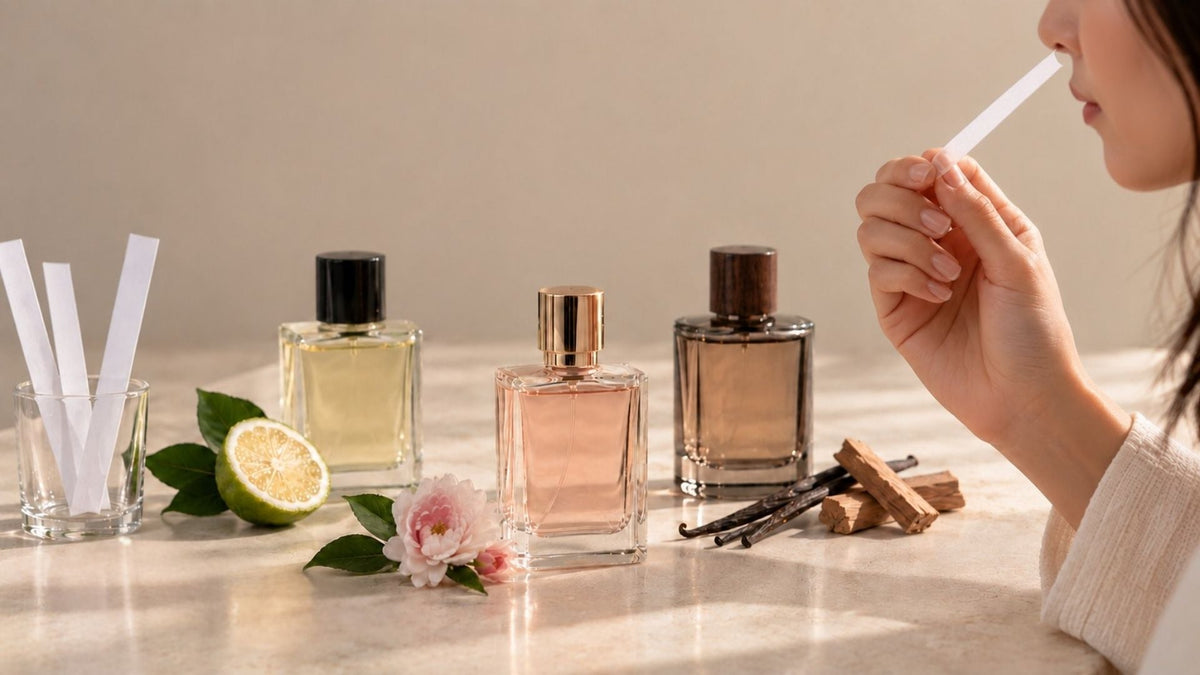
Blotter strips are useful for narrowing a larger group before testing fragrances on your skin. They can help you:
-
Eliminate obvious dislikes
-
Compare initial scent directions
-
Narrow a larger group to a few finalists
-
Avoid overwhelming your sense of smell
Label each strip so you can return to it after the first impression has settled.Paper is useful for screening, but it should not make the final decision. A fragrance can develop differently when worn, so your strongest candidates should still be tested on skin.
Step 8: Test Your Finalists on Skin
Once you are down to a few finalists, wear them on your skin rather than testing too many at once. Keep track of where each fragrance is applied, avoid rubbing it after spraying, and resist judging it from the opening alone.
Give each scent time to settle and check back on it as you go about your day. A fragrance that seems impressive at first may feel very different later, and one that starts quietly may become more appealing as it develops. What matters is whether you still enjoy having it around after the first impression has passed.
Step 9: Understand the Opening, Heart & Drydown
A fragrance does not stay exactly the same from the moment you apply it. What you smell at first can shift noticeably as it settles on the skin.
Opening
The opening is the first impression after application. This is often where the brighter, more volatile parts of a fragrance are easiest to notice.
Heart
The heart develops as the opening begins to fade and more of the fragrance's main character comes through.
Drydown
The drydown is the later, longer-lasting stage, when deeper and more persistent characteristics often become more noticeable.
For a signature scent, the drydown deserves just as much attention as the opening. You may spend far more time wearing this stage than smelling the first few minutes, so a fragrance should still feel right after it has had time to settle.
Step 10: Wear Each Finalist More Than Once
A single wear can give you a useful first impression, but it may not tell the whole story. Try your finalists on different days and in different parts of your normal routine, since mood, weather, surroundings, and even what you have been smelling earlier can affect how a fragrance comes across.
Your opinion may also change with familiarity. A scent that feels exciting at first can become tiring after a few wears, while another may grow on you once you have spent more time with it. When possible, use samples or smaller sizes before buying a full bottle so you have enough time to see whether the fragrance still feels right after the novelty of the first test wears off.
Step 11: Evaluate Fragrance Performance
Performance is about more than how many hours a fragrance lasts. For a signature scent, the better question is whether its strength, development, and wearability suit the way you actually want to use it.
Longevity
Consider whether the fragrance lasts long enough for your routine. More hours are not automatically better if you are happy with a lighter scent or do not mind reapplying.
Projection
Projection is how strongly the fragrance radiates around you. The ideal level depends on whether you prefer something discreet, noticeable, or more assertive.
Sillage
Sillage is the scent trail or presence a fragrance leaves as you move. A perfume can stay relatively close to the skin while still creating some presence around you.
Development
Pay attention to whether you enjoy the fragrance from the opening through the drydown, not just at one stage.
Wearability
This is the most practical test: do you actually want to reach for it regularly? A fragrance can perform well on paper and still be a poor signature scent if you rarely feel like wearing it.
Step 12: Choose the Right Concentration
Parfum, Eau de Parfum, Eau de Toilette, and Eau de Cologne are commonly associated with different fragrance concentrations, although the labels do not follow one fixed universal percentage scale.
Concentration can affect how a fragrance wears, but higher is not automatically better. Different versions of the same fragrance may also be formulated differently, so an EDP and EDT can smell somewhat different rather than simply stronger or lighter. Test the exact version you are considering before deciding.
The differences between these formats, including how concentration can affect the wearing experience, are covered in more detail in the Fragrance Concentration Guide.
How Many Perfumes Should You Test Before Choosing?
There is no set number of perfumes you need to test before choosing a signature scent. Start broadly enough to notice which scent directions appeal to you, then narrow the field once your preferences become clearer.
Spend more time with a small group of finalists rather than continually adding new options. If the comparisons start to blur together or make the decision harder, that is usually a sign to stop sampling and focus on what you already have. The goal is quality of testing rather than the number of fragrances tested.
Should Your Signature Scent Match Your Personality?
Your personality can be a useful starting point, but it does not determine which fragrance will suit you. Think of personal style as a way to generate possibilities rather than a set of scent rules.
|
Personal style |
Fragrance directions to consider |
|
Minimalist |
Clean musk, soft woods, fresh profiles |
|
Romantic |
Florals, soft amber, musk |
|
Adventurous |
Unusual woods, spices, green profiles |
|
Warm and approachable |
Vanilla, sandalwood, amber, soft gourmand |
|
Bold |
Oud-style woods, leather, rich florals, dark amber |
These associations are only suggestions. Someone with a minimalist style may love a rich amber fragrance, while someone who considers themselves bold may prefer a quiet skin scent. What matters is what you enjoy wearing, not what a personality label says you should smell like.
Should You Choose a Signature Scent by Season?
You can wear one signature scent year-round, but you do not have to. Some people prefer the consistency of one familiar fragrance, while others naturally reach for different scents in warmer and colder weather.
Your signature choices can also change by situation rather than season. You might have an everyday fragrance and a separate evening scent, or a small mix of warm-weather and cold-weather favorites.
A signature scent does not have to mean owning exactly one perfume. A small group of fragrances can still feel recognizably yours if they share the same general taste, mood, or scent character.
One Signature Scent vs a Signature Scent Wardrobe
Some people prefer one signature scent, while others like a small wardrobe of fragrances.
|
One Signature Scent |
Signature Scent Wardrobe |
|
Suits people who value consistency |
Suits people who enjoy variety |
|
Creates a strong association with one fragrance |
Allows different options for seasons or occasions |
|
Keeps fragrance choices simple |
Works well for day, evening, or changing preferences |
A signature scent wardrobe can still feel connected if the fragrances share a common thread, such as musk, vanilla, rose, citrus openings, or woody drydowns.
Can You Have a Signature Fragrance Note?
Yes. Instead of being known for one perfume, you may find that the same note or accord keeps appearing in the fragrances you enjoy.
That recurring element could be:
-
Vanilla
-
Musk
-
Rose
-
Amber
-
Vetiver
-
Sandalwood
-
Oud
-
Bergamot
Recognizing that pattern can make future fragrance choices easier. For example, understanding the different sides of musk scent, vetiver scent, amber scent, or oud fragrance can help you identify which interpretations of those notes suit your taste.
Should You Layer Fragrances to Create a Signature Scent?
Yes, but layering works best once you understand how each fragrance smells on its own. Combining scents can create a more personal result, but using too many at once makes it harder to tell which pairing is actually working.
If you find a combination you genuinely enjoy and keep returning to, it can become part of your signature scent. The principles behind how to layer fragrances can help you experiment more deliberately without overcomplicating the blend.
How to Know You've Found Your Signature Scent
Compliments can be nice, but they should not decide whether a fragrance is right for you.
You have probably found a strong candidate if:
-
You enjoy both the opening and the drydown.
-
You want to wear it again and again.
-
It fits naturally into your routine.
-
The strength feels comfortable.
-
You do not tire of it quickly.
-
You miss wearing it when you choose something else.
-
It feels like something you genuinely enjoy, not something you are trying to convince yourself to like.
The best sign is simple: you keep wanting to wear it, even when no one else is there to comment on it.
Should You Choose a Popular or Unique Fragrance?
Both can work as a signature scent. The difference is mainly in availability and how distinctive the fragrance may feel.
|
Popular fragrance |
Less common fragrance |
|
Easier to sample and widely available |
May feel more distinctive |
|
Often has broad appeal |
Can offer less familiar scent combinations |
|
May feel less unusual |
May be harder to sample or find |
A signature scent does not need to be rare. Personal association comes from wearing a fragrance you genuinely enjoy often enough for people to connect it with you.
Common Mistakes When Searching for a Signature Scent
A few habits can make fragrance testing more confusing than it needs to be.
Rushing the Test
-
Buying from the opening alone: Give the fragrance time to reach the drydown.
-
Testing too many fragrances at once: Too many scents can make clear comparison difficult.
-
Blind buying a full bottle: Sample first whenever practical.
Letting Other Signals Make the Decision
-
Choosing based only on notes: The same notes can smell very different across compositions.
-
Relying only on online descriptions: Descriptions can narrow the search, but they cannot replace smelling the fragrance.
-
Buying because it is trending: Popularity does not guarantee that a scent will suit you.
-
Assuming expensive means better: Price does not determine personal preference.
Focusing on the Wrong Measure
-
Prioritizing longevity above everything else: Long wear is not useful if you do not enjoy the fragrance throughout that time.
-
Choosing for compliments: Other people's reactions can be a bonus, but they should not decide what you wear.
Forcing Your Taste Into One Category
You do not need to belong to a single fragrance family. Preferences often cross categories, and combinations such as floral + musk or fresh + woody may describe your taste more accurately.
A Simple Signature Scent Test
Once you are down to a few finalists, rate each one from 1 to 5, with 1 being a poor fit and 5 being an excellent fit.
|
Category |
What to consider |
Score |
|
Opening |
First impression |
1–5 |
|
Heart |
How much you enjoy it once the opening settles |
1–5 |
|
Drydown |
How it smells later in the wear |
1–5 |
|
Comfort |
How natural and easy it feels to wear |
1–5 |
|
Distinctiveness |
Whether it has enough character for you |
1–5 |
|
Versatility |
How well it works across your usual situations |
1–5 |
|
Projection preference |
Whether the level of presence feels right |
1–5 |
|
Longevity satisfaction |
Whether it lasts long enough for your needs |
1–5 |
|
Lifestyle fit |
How naturally it fits your routine |
1–5 |
|
Desire to wear again |
How much you want to reach for it again |
1–5 |
The scores can help organize your thoughts, but they do not have to make the decision for you. Ask yourself one more thing:
If all the bottles disappeared tomorrow, which one would you immediately want back?
That answer may be more revealing than the total score.
Conclusion
Finding a signature scent starts with understanding what you already enjoy rather than sampling popular fragrances at random. Fragrance families, scent character, lifestyle, concentration, and performance can help narrow the options, but skin testing and repeated wear are what show whether a fragrance still feels right after the opening has passed.
Your signature can be one perfume, a recurring note, or a small group of fragrances that share a recognizable style. What matters most is that you genuinely want to keep wearing it. If you are still narrowing down the direction that suits you, VINEVIDA’s Perfume Fragrance Oils can help you compare different scent profiles and identify the styles you naturally keep coming back to.
Frequently Asked Questions
What is a signature scent?
A signature scent is a fragrance you return to often enough that it starts to feel associated with you. It can be one perfume or a small group of scents that share a recognizable style.
How do I know which perfume suits me?
Pay attention to what survives repeated wear. If you still enjoy the fragrance after the opening fades, feel comfortable with its strength, and keep wanting to wear it again, it is probably a good fit.
Should I test perfume on paper or skin?
Use paper to narrow your options, then test the finalists on skin. The blotter helps with first impressions; wearing the fragrance shows you how it actually develops over time.
How do I choose between two fragrances I love?
Wear them on separate days and stop adding new contenders. If both still appeal to you, ask which one you would miss more if you could no longer wear it.