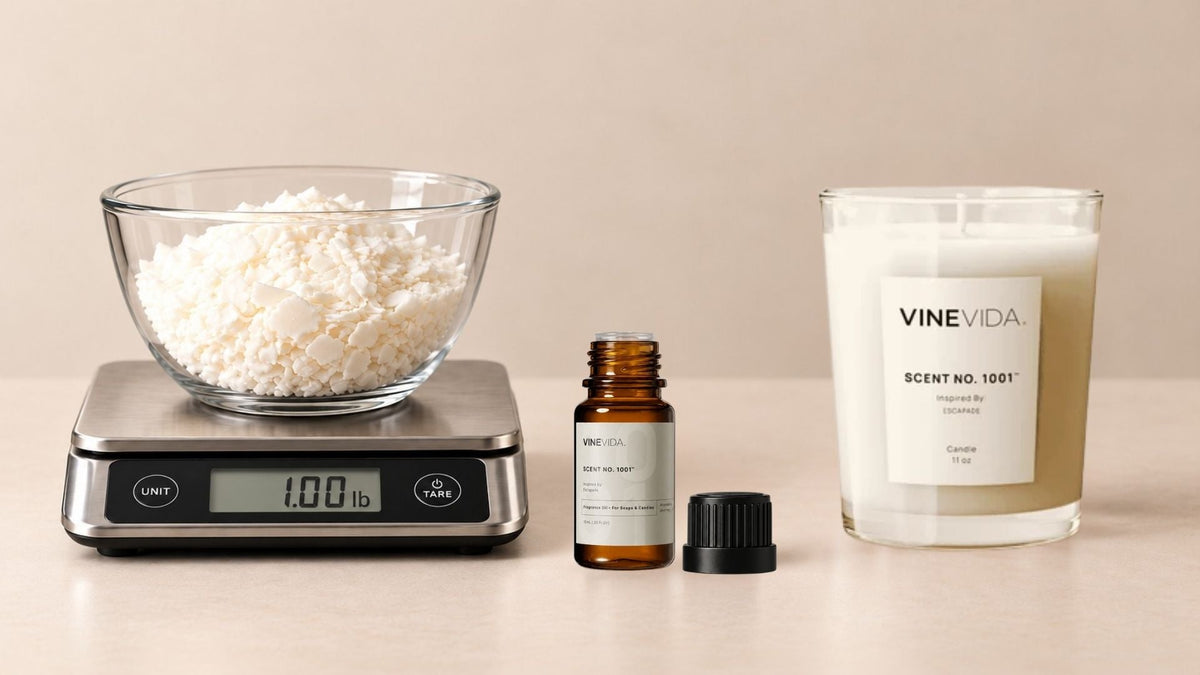
One ounce of fragrance oil per pound of wax is a common starting point in candle making, but it is not a formula that works for every candle. Different waxes have different fragrance capacities, so the amount you can use depends on the specific wax and its manufacturer’s guidance.
Fragrance oil should be calculated by weight because candle fragrance loads are weight-based percentages, not volume measurements. Using more fragrance oil also does not automatically produce stronger scent throw; once the amount is no longer appropriate for the wax and candle system, adding more can lead to performance problems instead of a better-smelling candle.
This guide explains how much fragrance oil per pound of wax to use, how to calculate fragrance load for any batch size, and how wax type affects the amount you can test. It also covers the difference between maximum and best-performing fragrance loads so you can scale a candle formula without simply assuming that more fragrance is better.
How Much Fragrance Oil Should You Use Per Pound of Wax?
A practical starting point for many candle formulas is 1 oz of fragrance oil per 1 lb (16 oz) of wax. That equals a 6.25% wax-basis fragrance load.
1 oz ÷ 16 oz × 100 = 6.25%
This is a starting point, not a universal formula. Some waxes recommend less, while others can retain considerably more, so always check the manufacturer’s maximum for the exact wax you are using. Lone Star currently uses 1 oz per pound as a common starting point and lists wax-dependent capacities ranging from roughly 3% to 11%.
The ideal load may still be below the maximum. Testing the actual wax + fragrance + wick system is what determines the amount that performs best.
What Is Fragrance Load?
Fragrance load tells you how much fragrance oil is added compared with the amount of wax used. The percentage can vary depending on the calculation method. Here, fragrance load is based on the weight of the wax:
Fragrance Load % = Fragrance Oil Weight ÷ Wax Weight × 100
For example:
1 oz fragrance ÷ 16 oz wax × 100 = 6.25%
Some candle makers and calculators base the percentage on the total finished formula instead. Because of this, you may see a slightly different percentage for the same recipe. That is why it is important to check which calculation method is being used when comparing formulas.
Fragrance Load vs Fragrance Content
The same candle formula can show two different percentages depending on how the calculation is done.
Wax-Basis Fragrance Load
This method calculates fragrance oil as a percentage of the wax weight.
For example:
-
16 oz wax
-
1.28 oz fragrance oil
1.28 ÷ 16 × 100 = 8% fragrance load
Unless noted otherwise, the examples below use the wax-weight method.
Finished-Formula Fragrance Percentage
This method calculates fragrance oil as a percentage of the total finished candle weight, including both wax and fragrance.
Using the same formula:
-
16 oz wax
-
1.28 oz fragrance oil
-
17.28 oz total
1.28 ÷ 17.28 × 100 = 7.41%
So the same candle can be described as 8% on a wax basis or about 7.4% of the finished formula. Both are mathematically correct; they simply use different calculation methods.
Fragrance Oil Per Pound of Wax Quick Reference
Use this table to see how much fragrance oil corresponds to common wax-basis fragrance loads for 1 lb (16 oz) of wax.
|
Fragrance Load |
Fragrance Oil per 1 lb Wax |
|
4% |
0.64 oz |
|
5% |
0.80 oz |
|
6% |
0.96 oz |
|
6.25% |
1.00 oz |
|
7% |
1.12 oz |
|
8% |
1.28 oz |
|
9% |
1.44 oz |
|
10% |
1.60 oz |
|
11% |
1.76 oz |
|
12% |
1.92 oz |
These figures are calculations, not universal recommendations. Never exceed the tested maximum for the specific wax you are using.
Wax fragrance capacity can vary considerably, so always check the current manufacturer guidance before choosing a fragrance load to test.
How to Calculate Fragrance Oil for Candle Wax
For a wax-basis fragrance load, use this formula:
Wax Weight × Fragrance Load = Fragrance Oil Weight
Convert the fragrance-load percentage to a decimal before multiplying. For example, 8% becomes 0.08.
Example: 1 Pound of Wax at 8%
16 oz × 0.08 = 1.28 oz fragrance oil
Example: 2 Pounds of Wax at 8%
32 oz × 0.08 = 2.56 oz fragrance oil
Example: 5 Pounds of Wax at 7%
80 oz × 0.07 = 5.6 oz fragrance oil
The same formula works when measuring in grams. VINEVIDA's Fragrance Calculator gives a quicker way to work out how much fragrance oil to use for a batch.
How to Calculate Fragrance Oil in Grams
The same fragrance-load formula works in grams:
Wax Weight in Grams × Fragrance Load = Fragrance Oil Weight in Grams
For example:
500 g wax × 0.08 = 40 g fragrance oil
1,000 g wax × 0.08 = 80 g fragrance oil
Measuring in grams can be especially useful for:
-
Small test batches
-
Precise formulation
-
Scaling production batches
-
Recording formulas consistently
Grams also make small amounts easier to measure without working with fractional ounces.
How Much Fragrance Oil for Half a Pound of Wax?
Half a pound equals 8 oz of wax. Using a wax-basis calculation:
-
6%: 8 × 0.06 = 0.48 oz fragrance oil
-
8%: 8 × 0.08 = 0.64 oz fragrance oil
-
10%: 8 × 0.10 = 0.80 oz fragrance oil
These are calculation examples, not universal recommendations. Check the fragrance-load guidance for your specific wax before choosing a percentage to test.
How Much Fragrance Oil for 2 Pounds of Wax?
Two pounds equals 32 oz of wax. Using a wax-basis calculation:
-
6%: 32 × 0.06 = 1.92 oz fragrance oil
-
8%: 32 × 0.08 = 2.56 oz fragrance oil
-
10%: 32 × 0.10 = 3.20 oz fragrance oil
The fragrance percentage stays the same as the batch scales up; only the ingredient weights change.
How Much Fragrance Oil for 5 Pounds of Wax?
Five pounds equals 80 oz of wax. Using a wax-basis calculation:
-
6%: 80 × 0.06 = 4.8 oz fragrance oil
-
8%: 80 × 0.08 = 6.4 oz fragrance oil
-
10%: 80 × 0.10 = 8.0 oz fragrance oil
These examples show how the same percentage scales with a larger batch. Use a fragrance load that falls within the guidance for your specific wax rather than treating every percentage above as a recommendation.
How Much Fragrance Oil for Soy Wax?
Soy wax does not have one universal fragrance load. The right amount depends on the exact soy wax you are using.
Current supplier guidance shows how much soy waxes can vary. Lone Star lists NatureWax C-3 at about 6%, Golden Brands 464 at 7–9%, and Golden Brands 444 at 9–11%.
Before choosing a fragrance load:
-
Check the specification for your exact soy wax.
-
Start within the manufacturer or supplier guidance.
-
Test the candle rather than automatically using the maximum.
-
Do not assume one soy wax will behave like another.
A formula that works well with 464, for example, should not automatically be applied to every other soy wax.
How Much Fragrance Oil for Paraffin Wax?
Paraffin wax does not have one universal fragrance load because different paraffin formulations can hold different amounts of fragrance oil. Some container paraffin blends are listed around 6–10%, while certain straight or base paraffins may be closer to 3–4% without additives.
Check the specification for the exact paraffin wax or blend you are using rather than choosing a percentage based on the word paraffin alone.
How Much Fragrance Oil for Coconut Wax & Blends?
Coconut wax and coconut-based blends can have very different fragrance capacities, so there is no single percentage that applies to all of them. For example, Lone Star currently lists Golden Brands 454 coconut-soy wax at a 5–10% maximum fragrance load.
Always follow the specification for the exact wax you are using rather than estimating capacity from the word coconut alone.
How Much Fragrance Oil for Pillar Wax?
Pillar wax does not have one universal fragrance load. Some pillar and votive waxes are rated around 6%, while other waxes may allow less.
Pillar wax is formulated differently from container wax because it needs to hold its shape and support a different burn system. That is why you should check the maximum fragrance load for the exact pillar wax you are using rather than applying a container-wax percentage to it.
Maximum Fragrance Load vs Best Fragrance Load
A wax's maximum fragrance load is the highest amount of fragrance oil the manufacturer says it can hold. That number is a limit, not a recommendation to use the full amount in every candle.
The best fragrance load is the amount that gives the best overall result in your specific formula. A wax may be rated for 10%, for example, but your candle could perform better at 6%, 7%, or 8% once the fragrance, wick, vessel, cure, and burn performance are taken into account.
In other words, being able to use more fragrance does not mean you should. The goal is to find the load that gives you the scent and burn performance you want without pushing the wax to its maximum unnecessarily.
Why More Fragrance Oil Doesn't Always Mean Stronger Scent
Adding more fragrance oil does not always make a candle smell stronger. Once the wax reaches an appropriate fragrance load, adding more may do little for scent throw and can start to affect how the candle burns.
Too much fragrance oil can contribute to:
-
Sweating or seepage
-
Oil separation
-
Wick problems
-
Poor combustion
-
An uneven melt pool
-
Excessive smoke or soot
-
Little or no improvement in scent throw
A weak-smelling candle may have other problems besides fragrance load. Wick choice, wax compatibility, cure time, and the fragrance itself can all influence cold and hot throw performance, so simply adding more oil may not solve the problem.
What Happens If You Add Too Much Fragrance Oil?
Adding more fragrance oil than the wax can properly handle can lead to seepage, separation, wick problems, and poor burn performance. It also does not guarantee stronger scent throw.
Fragrance Sweating
Excess oil may appear as droplets or an oily film on the candle surface. Too much fragrance can be one cause, although sweating can happen for other reasons as well.
Separation
If the wax cannot retain all of the fragrance oil, some of it may separate instead of staying evenly incorporated.
Poor Burn Performance
Fragrance oil is part of the candle’s fuel system, so changing the load can affect how the candle burns and how the melt pool develops.
Wick Problems
A wick that worked well at one fragrance load may not perform the same way after the formula changes. Any meaningful increase in fragrance should be followed by another burn test.
Soot & Smoke
An overloaded or poorly balanced candle may produce more smoke or soot during burning, especially if the wick and fragrance load are no longer working well together.
Safety & Stability Concerns
Stay within the tested limits for the wax and fragrance system you are using. The Flaming Candle notes that exceeding the wax manufacturer’s fragrance-load recommendation can contribute to poor burning and fragrance seepage.
What Happens If You Use Too Little Fragrance Oil?
Using too little fragrance oil can leave a candle smelling faint, both before lighting and while it burns. The fragrance may simply feel less noticeable than intended.
That does not automatically mean the load needs to go up. Wick choice, wax compatibility, cure time, fragrance chemistry, room size, and the candle-making process can all affect cold and hot throw.
If the scent feels weak, look at the whole candle system before changing the percentage. Increasing the fragrance load should be one possible adjustment, not the automatic first response.
How to Choose Your Starting Fragrance Load
A controlled starting process is more useful than choosing the highest number on the wax specification.
1. Read the Wax Specification
Find the exact wax product and identify its stated fragrance-load limit or recommended range.
Do not rely only on broad labels such as soy, paraffin, or coconut.
2. Check Fragrance Supplier Guidance
Confirm that your fragrance oil is intended for candle use and review its current supplier documentation.
For VINEVIDA projects, select the appropriate candle-compatible product from the Candle Fragrance Oils collection rather than assuming an oil intended for another application is interchangeable.
3. Choose a Conservative Starting Point
One ounce per pound, or 6.25% on the wax-basis calculation used here, is a common benchmark when it falls within the guidance for your wax.
If your wax specifies a lower limit, use the lower limit instead.
4. Make a Small Test Batch
Avoid scaling an untested fragrance percentage directly into production.
A few small candles are cheaper and easier to compare than an entire batch that later needs reformulation.
5. Cure Consistently
Use the same cure conditions and evaluation point between comparison candles.
Otherwise, a difference in cure may be mistaken for a difference in fragrance percentage.
6. Evaluate Cold & Hot Throw
Smell the candle unlit after the appropriate cure, then evaluate hot throw as part of a controlled burn test.
Do not judge a fragrance percentage by bottle strength alone.
7. Adjust One Variable at a Time
If you compare 6%, 7%, and 8%, keep the other major variables as consistent as possible:
-
Wax
-
Fragrance
-
Wick
-
Vessel
-
Batch process
-
Cure conditions
-
Test environment
That makes it much easier to identify whether fragrance load actually caused the difference.
How to Test Different Fragrance Loads
If your wax and fragrance guidance allows it, you might compare three otherwise identical candles:
Test A: 6%
Test B: 7%
Test C: 8%
Keep the wax, fragrance, wick, vessel, process, and cure conditions the same so the fragrance load is the main variable changing between tests.
Compare each candle for:
-
Cold throw
-
Hot throw
-
Burn behavior
-
Wick performance
-
Smoke or soot
-
Sweating or separation
-
Overall scent quality
The strongest-smelling candle is not automatically the best formula. If a lower load already gives good scent and burn performance, there is no need to test the wax's maximum simply because it is available.
Does Every Fragrance Oil Need the Same Percentage?
Fragrance oils do not all perform the same way at the same load. Differences in composition, volatility, scent strength, and how the fragrance interacts with the wax can change both scent throw and overall candle performance.
A fragrance that works well at 6% in one formula may perform better at a different load in another. The best percentage depends on the wax, fragrance, wick, and vessel working together.
Does Fragrance Oil Density Affect the Calculation?
Not when you measure the fragrance oil by weight. Density only becomes relevant if you try to convert between weight and volume.
A fluid ounce measures volume, while an ounce on a scale measures weight, so the two are not automatically equal. For accurate candle formulas, weigh both the wax and fragrance oil on a digital scale rather than measuring fragrance with cups or other volume-based tools.
Should You Measure Fragrance Oil in Ounces or Grams?
Either unit works as long as you measure the fragrance oil by weight.
Ounces
Ounces are a natural fit when the rest of your candle formula is already written in pounds and ounces.
For example:
16 oz wax × 8% = 1.28 oz fragrance oil
Grams
Grams are often more convenient for smaller test batches, precise formulation, metric production, and scaling.
For example:
500 g wax × 8% = 40 g fragrance oil
Whichever unit you use, keep it consistent throughout the formula so the wax and fragrance calculations stay easy to follow.
Fragrance Load vs Jar Size
An 8 oz candle jar does not necessarily hold 8 oz of wax. Fragrance load should be calculated from the actual wax weight used in the formula, not the jar name or its container volume.
For example, if an 8 oz jar uses 6.5 oz of wax, calculate the fragrance from 6.5 oz of wax, not from 8 oz.
If you are calculating from a target finished candle weight that includes both wax and fragrance, use the appropriate finished formula calculation instead.
How to Calculate Wax and Fragrance for a Target Finished Candle Weight
If your target fill weight already includes both wax and fragrance, do not treat that full amount as wax and then add fragrance on top.
For a wax basis load:
Wax Weight = Target Finished Weight ÷ (1 + Fragrance Load)
Then subtract the wax weight from the target fill to get the fragrance weight.
Example: 10 oz Finished Candle at 8%
10 ÷ 1.08 = 9.26 oz wax
That leaves 0.74 oz fragrance oil, giving a finished fill of 10 oz.
How to Scale a Candle Formula Up or Down
Once you have a tested candle formula, you can make a larger or smaller batch by keeping the same percentages.
For example, a formula with:
-
1,000 g wax
-
80 g fragrance oil
uses an 8% fragrance load.
For half the batch, use:
-
500 g wax
-
40 g fragrance oil
For three times the batch, use:
-
3,000 g wax
-
240 g fragrance oil
The fragrance load stays at 8% each time. Scaling by weight and percentage is more reliable than using bottle caps, spoonfuls, or other approximate measurements.
Double Scenting & Triple Scenting: What Do These Terms Mean?
Double scenting and triple scenting are traditional candle making terms based on a starting point of about 0.5 oz of fragrance oil per pound of wax. Lone Star currently uses the terms this way:
-
Single scent: about 0.5 oz/lb
-
Double scenting: about 1 oz/lb
-
Triple scenting: about 1.5 oz/lb
These labels do not override the fragrance load for your wax. Triple scenting, for example, is only appropriate if the wax is designed to hold that amount. For formulation, actual weights and percentages are clearer than relying on terms such as double or triple scented.
Fragrance Load Mistakes That Cause Bad Calculations
A few calculation mistakes can throw off an otherwise sound candle formula.
Calculating From Jar Size
Calculate from the actual wax or formula weight, not the size printed on the jar.
Measuring by Volume
Measure wax and fragrance oil by weight. Fluid ounces and ounces by weight are not the same measurement.
Confusing 1 oz/lb With Exactly 6%
One ounce of fragrance oil per 16 oz of wax equals 6.25% on a wax basis. The 6% figure you may see elsewhere is usually rounded.
Treating Maximum Load as Recommended Load
The maximum tells you how much fragrance the wax is designed to hold. It does not mean that amount will give the best candle.
Assuming Every Wax Holds 10%
Fragrance capacity varies from one wax formulation to another. Check the specification for the exact wax you are using.
Assuming Every Fragrance Needs the Same Load
Two fragrance oils can perform differently at the same percentage, so changing the fragrance may also mean retesting the load.
Changing Load Without Retesting the Wick
A change in fragrance level can affect how the candle burns. Retest wick performance after making a meaningful change to the formula.
Mixing Percentage Conventions
Check whether the percentage is based on wax weight or the total finished formula before comparing recipes or calculator results.
Conclusion
One ounce of fragrance oil per pound of wax is a useful starting point and equals 6.25% on a wax basis, but it is not a universal recommendation. Wax capacities vary, so check the fragrance load guidance for the exact wax you are using and measure both wax and fragrance oil by weight.
The maximum fragrance load is not necessarily the amount that will give the best result. Adding more fragrance can affect wick behavior and burn performance without improving scent throw, so controlled testing is the most reliable way to find the right load for your candle system. Once you are ready to choose a fragrance for your next batch, VINEVIDA offers options made for candle-making projects.
Frequently Asked Questions
How much fragrance oil per pound of wax should I use?
A common starting point is 1 oz of fragrance oil per 1 lb of wax, which equals 6.25% when calculated against the wax weight. The amount you ultimately use depends on the fragrance capacity of your wax and how the finished candle performs during testing.
What percentage is 1 oz of fragrance oil per pound of wax?
One ounce of fragrance oil for 16 oz of wax is 6.25% on a wax basis.
1 ÷ 16 × 100 = 6.25%
You may also see this rounded to 6% or 6.3% in candle making guidance.
How much fragrance oil should I use for 1 lb of soy wax?
There is no single percentage that works for every soy wax. Depending on the formulation, supplier specifications can range from around 6% to 11%, so the fragrance load should be based on the particular soy wax you are using rather than a general rule for soy candles.
Should I always use the maximum fragrance load?
No. The maximum tells you how much fragrance the wax is designed to retain, not how much you need to use. A candle rated for a 10% maximum may perform better at a lower load once scent throw, wick behavior, sweating, and overall burn quality are considered.
Does more fragrance oil make a candle smell stronger?
Not always. Increasing the fragrance load may help in some formulas, but adding more than the candle system can handle can lead to separation, sweating, wick problems, or poor burning without noticeably improving scent throw. Weak scent can also come from the wax, wick, cure, fragrance, or candle making process.
Should fragrance oil be measured by weight or volume?
Measure fragrance oil by weight, using either grams or ounces on a digital scale. Fluid ounces, measuring cups, and teaspoons measure volume, and fragrance oils can vary in density, so those measurements do not give the same precision when calculating fragrance load.