A fragrance can smell excellent in the bottle and still perform very differently in a finished candle. Successful candle scenting depends on the fragrance, wax, fragrance load, processing temperature, mixing, wick, vessel, cure period, and testing conditions.
That is why learning how to scent candles involves more than pouring fragrance oil into melted wax. Adding more fragrance does not automatically make a candle smell stronger. The problem may come from the wax, wick, cure time, or how the candle was made. More fragrance will not fix those issues.
This guide walks through the main steps of scenting and measuring it to mixing, curing, and testing the finished candle. Keeping the same measurements and notes from one batch to the next also makes it easier to see what changed when a result is different.
How to Scent Candles
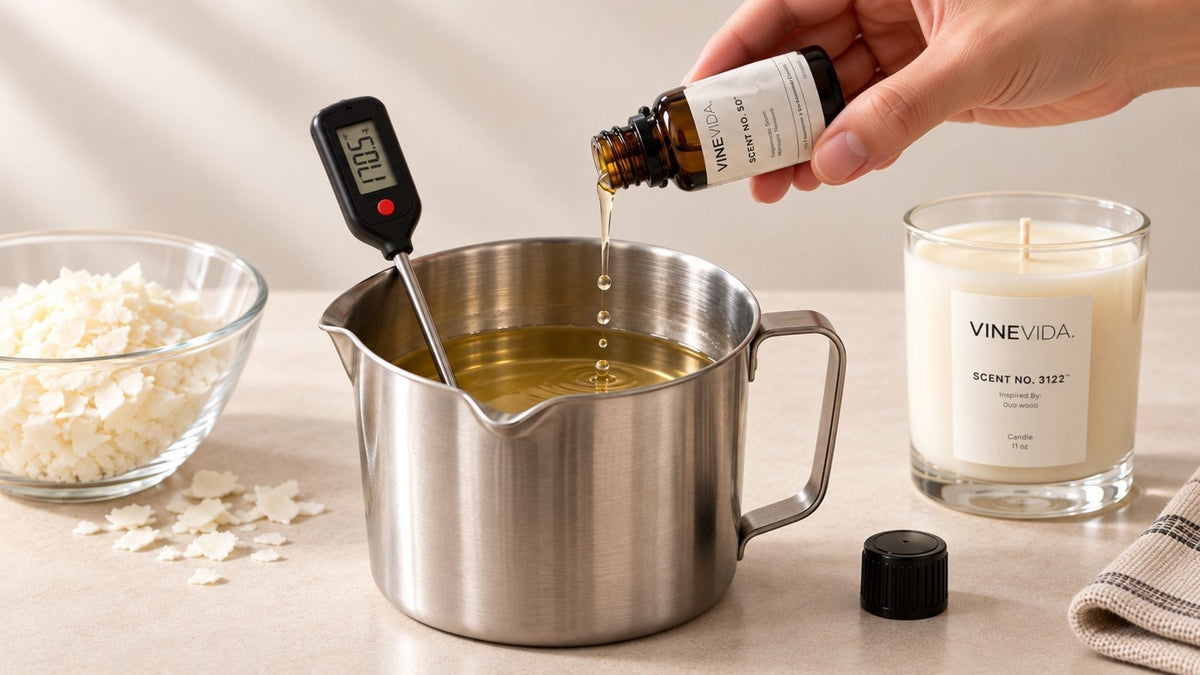
To scent candles, choose a candle-compatible fragrance and suitable wax, determine an appropriate fragrance load, weigh the wax and fragrance accurately, melt the wax according to the manufacturer's directions, add and mix the fragrance at the recommended temperature, pour the candle, allow it to cool and cure, and then test cold and hot scent throw.
A practical process looks like this:
-
Choose a candle-compatible fragrance.
-
Select your candle wax.
-
Check the wax's fragrance-load guidance.
-
Calculate and weigh the fragrance.
-
Melt the wax.
-
Add fragrance at the recommended temperature.
-
Mix the fragrance thoroughly into the wax.
-
Pour the candle.
-
Allow the candle to cool and cure.
-
Test cold and hot scent throw.
-
Adjust one variable at a time.
Step 1: Choose a Candle-Compatible Fragrance
There is no single fragrance amount or temperature that works for every candle. Use the guidance for the wax and fragrance you have. Measure carefully, then follow the same process when you make the next batch.
Candle fragrance oils are one option, and some essential oils can also be used if they are suitable for candles. Other blended fragrance products may work as well, but only when the supplier identifies them for candle use. Fragrance Oils for Candle Making can help narrow the choice to oils intended for this application, while the individual supplier guidance should still be checked before adding any fragrance to wax.
Can You Use Fragrance Oil to Scent Candles?
Yes, as long as the fragrance oil is suitable for candle use. Candle fragrance oils are widely used because they offer a broad choice of scent profiles, make layered accords possible, and can provide more consistent results from batch to batch.
Established suppliers may also provide candle-specific usage or performance information. Before choosing one, confirm that it is intended for candles and review the supplier's recommended use guidance, since performance can still vary with the wax, wick, vessel, and overall candle formula.
Can You Use Essential Oils in Candles?
Some essential oils are used in candles, but they don't all perform the same way. Hot throw can be weaker or different from what you smell in the bottle, so check each oil individually and test it in your wax before making a full batch.
Can You Use Perfume to Scent Candles?
Finished perfume or cologne generally should not be used as a substitute for candle fragrance oil. Personal fragrances are formulated for wear on the body, not for a wax-and-wick system, and may contain alcohol, water, or other carriers that are not appropriate for candle formulation.
Their burn behavior may not have been established for that use, so fragrance materials specifically intended for candle making are the better choice.
Step 2: Choose Your Candle Wax
Wax influences how a candle holds and releases fragrance, as well as how it burns. Fragrance capacity and processing requirements vary by the specific wax, so the wax you choose becomes part of the scenting formula.
Soy Wax
Soy wax is popular for container candles. Its fragrance capacity and processing requirements depend on the particular formulation, so one set of fragrance-load or temperature recommendations should not be applied to every soy wax.
Paraffin Wax
Paraffin is widely used in candle making and can provide strong fragrance performance in many candle systems. The appropriate fragrance load and process still depend on the specific paraffin wax or blend being used.
Coconut & Coconut Blends
Coconut wax is often used as part of a blend rather than as a single-wax formula. How the wax handles fragrance and how you work with it can change based on the coconut wax blend.
Beeswax
Beeswax has a natural aroma of its own, which can influence how an added fragrance is perceived. It also has different scenting and burn considerations from common soy or paraffin container waxes.
Wax Blends
Wax blends combine two or more waxes, but their name does not indicate how they will behave. The actual mix can change how the candle burns, looks, and handles fragrance.
Choosing Fragrance Oils for Candles with the wax system in mind can help narrow suitable fragrance options, but the specifications for the individual wax should guide fragrance load and processing.
Step 3: Check the Wax's Recommended Fragrance Load
Fragrance load is the percentage of fragrance used in relation to the wax or formula. The exact calculation can vary, so used the method given for the wax or recipe you are following.
A wax's maximum fragrance load should be treated as a limit, not automatically as the best target for scent performance. Using more fragrance can sometimes create problems without producing a stronger throw, so the supplier's current recommendations should guide the amount you test.
Step 4: Calculate How Much Fragrance Oil You Need
Calculate the fragrance amount from your chosen fragrance load:
Fragrance oil amount = wax amount × fragrance-load percentage
For 500 g of wax at 8%:
500 × 0.08 = 40 g fragrance oil
Measure fragrance by weight, not by drops, and use grams or ounces consistently. The percentage will vary by wax and fragrance. CandleScience, for example, uses 6% as the starting load in one beginner soy-candle recipe rather than treating one percentage as a universal standard.
For larger batches, fragrance oil calculations by wax weight can help with pound-based amounts, conversions, and scaling.
Step 5: Measure Fragrance Oil by Weight
Use the digital scale rather than estimating fragrance with drops, teaspoons, bottle caps, or by eye. A weight measurement gives you something you can repeat the next time you make the candle.
Write down the wax weight, fragrance weight, and percentage for each test batch. Those notes make it easier to see what changed if one batch turns out differently from another.
Step 6: Melt the Wax Correctly
Use the melting instructions for the wax you have, and keep an eye on the temperature with a thermometer while it melts. Do not assume every wax should be heated the same way, because the recommended temperature can vary one wax to another.
Do not rely on one universal melt temperature for every wax. Keep heating wax and fragrance materials away from ignition sources, and never leave melting wax unattended.
Step 7: When Should You Add Fragrance Oil to Candle Wax?
Add fragrance oil at the temperature recommended for the specific wax and process you are using. The ideal range can vary with the wax formulation, fragrance, and manufacturer instructions, so one temperature should not be treated as universal.
Current supplier guidance shows that variation. CandleScience adds fragrance at 185°F (85°C) in its beginner soy-candle process, while Lone Star lists about 180°F (82°C) for soy and paraffin and 200–205°F (93–96°C) for palm wax.
For consistent testing:
-
Check the guidance for your wax.
-
Reach the recommended fragrance-add temperature.
-
Add the measured fragrance.
-
Record the temperature.
-
Repeat the same process in comparison batches.
Does Fragrance Oil Flash Point Determine When You Add It?
No. Flash point is a flammability-related property, not the temperature that tells you when fragrance should be added to candle wax.
A fragrance can be added to wax above its flash point without automatically igniting. Ignition requires an appropriate source, such as a spark or open flame, which is why fragrance materials should always be kept away from ignition sources while you work.
Step 8: Mix the Fragrance Into the Wax Thoroughly
Stir the fragrance gently through the entire batch, reaching the sides and bottom of the vessel without unnecessary splashing or aggressive agitation. Keep the same mixing method between test batches so the results are easier to compare.
Some supplier processes recommend about two minutes of gentle stirring. CandleScience, for example, recommends 1–2 minutes in its beginner soy process, but the appropriate method should still follow the guidance for the wax you are using.
Step 9: Pour the Scented Wax
Once the fragrance is fully mixed, follow the wax manufacturer's recommended cooling and pouring process.
Have the containers ready, pour consistently, and avoid unnecessary process changes between test batches. If you are troubleshooting scent performance, record the pour temperature along with the fragrance-add temperature.
Step 10: Let the Candle Cool and Cure
Once the candle is poured, leave it until the wax has fully set. Curing happens after that, when the candle rests before you test how the scent performs.
Cure time varies by wax, so testing a candle as soon as it has set may not reflect its final scent performance. Follow the wax supplier's recommended cure period and keep that timing consistent when comparing batches.
Lone Star, for example, recommends about a week of curing in its general candle-making guidance, though other waxes may call for different periods.
Step 11: Test Cold Throw
Cold throw is how the candle smells while it is unlit.
After the appropriate cure period, evaluate:
-
Scent strength
-
Fragrance character
-
Balance between notes
-
Any changes from the fragrance in the bottle
-
Consistency between candles from the same batch
A candle can smell strong while unlit and still seem much weaker once it is burning. That is why cold and hot scents need to be tested separately.
Step 12: Test Hot Throw
Hot throw is how the fragrance is perceived while the candle is burning.
Evaluate the candle under consistent conditions and consider the following:
-
Scent presence
-
Room coverage
-
Fragrance character
-
Consistency during the burn
-
Melt-pool development
-
Flame and wick behavior
Hot throw depends on more than fragrance load. The wax, fragrance, wick, vessel, cure period, melt pool, room conditions, and overall formula can all affect the result. Candle Fragrance Oils covers cold and hot throw performance in more detail.
Why Wick Choice Affects Candle Scent
The wick influences flame behavior, heat output, melt-pool development, fragrance release, and overall burn performance.
A candle can contain an appropriate amount of fragrance and still have weak hot throw if the wick, wax, and vessel are not working well together. Current supplier guidance also identifies wick sizing and melt-pool development as factors that can affect scent performance.
Actual wick sizing is outside the scope of this guide, but wick performance should be checked before assuming that weak scent is caused by the fragrance oil.
Why Does My Candle Smell Good Cold but Not When Burning?
If a candle has noticeable cold throw but weak hot throw, fragrance load is only one possible cause.
Check:
-
Wick suitability
-
Melt-pool development
-
Cure period
-
Wax-and-fragrance compatibility
-
Fragrance load
-
Testing environment
-
Burn conditions
-
Processing consistency
A strong cold throw does not guarantee that the candle will release fragrance effectively while burning. Check the wick, melt pool, and overall burn performance before increasing the fragrance amount.
Why Does My Candle Smell Weak?
Weak scent can come from more than the amount of fragrance in the candle. Before changing the formula, work through the process and burn setup so you can narrow down where the problem is coming from.
-
Start with the fragrance. Confirm that it is intended for candle use.
-
Check the fragrance load. Make sure the amount falls within the appropriate range for the wax and fragrance. Adding more oil is not automatically the answer.
-
Look back at the addition temperature. Compare the temperature you used with the wax supplier's guidance for adding fragrance.
-
Think about mixing. The fragrance needs to be distributed evenly through the wax rather than concentrated in part of the batch.
-
Give the candle enough time to cure. Test after the recommended cure period, and use the same timing when you compare one batch with another.
-
Do not overlook the wick. If hot throw is weak, check the flame, melt pool, and overall burn before assuming the fragrance amount needs to change.
-
Consider where you are testing it. Room size and airflow can change how noticeable the scent feels. The same candle may seem much stronger in a small bedroom than in a large open-plan space.
-
Change one thing for the next test. If you adjust the wick, fragrance load, temperature, and cure period together, you will not know which change actually affected the result.
Does Adding More Fragrance Oil Make a Candle Smell Stronger?
Not necessarily. Increasing the fragrance load does not guarantee stronger cold or hot throw.
Too much fragrance can contribute to:
-
Oil separation
-
Surface sweating
-
Burn-performance problems
-
More difficult troubleshooting
Wax has practical fragrance limits, and exceeding them does not automatically improve scent performance. CandleScience also cautions that adding more fragrance may create burn issues without producing a stronger scent.
If a candle smells weak, check the wax, wick, cure, and process before increasing the fragrance load.
How to Blend Fragrance Oils for Candles
Start with fragrances that are suitable for candle use, then measure the blend by weight and treat it as the total fragrance amount in the formula.
For example, if a candle calls for 40 g total fragrance, a two-oil blend might use:
-
24 g fragrance A
-
16 g fragrance B
That 40 g is the full fragrance amount for the candle, not 40 g of each oil. Test the blend in the chosen wax before scaling it up, since a combination that smells good on its own may perform differently in the finished candle.
How to Make Candle Scent Stronger
If the candle smells too weak, do not add more fragrance right away. First check the wax, wick, cure time, and the way the candle was made.
Focus on:
-
Start with a fragrance that is intended for candle use.
-
Check that the fragrance load fits the wax and fragrance you are working with.
-
Use the processing guidance for that wax rather than relying on one method for every batch.
-
Keep your mixing method the same when comparing results.
-
If the hot throw is weak, check whether the wick is working well with the candle.
-
Give the candle the recommended cure time before judging the scent.
-
Test it in a room that reflects how the candle will actually be used.
-
When you make an adjustment, change only one thing so you can tell what affected the result.
How to Keep Candle Scenting Consistent Between Batches
If you want to compare one batch with the next, write down what you did each time. That gives you something concrete to check when a candle turns out differently.
|
Batch detail |
What to record |
|
Wax |
Exact wax or blend used |
|
Wax lot |
Batch or lot when relevant |
|
Fragrance |
Exact fragrance name |
|
Fragrance supplier |
Supplier or source |
|
Wax weight |
Actual measured weight |
|
Fragrance weight |
Actual measured weight |
|
Fragrance load |
Percentage and calculation method |
|
Add temperature |
Wax temperature when fragrance was added |
|
Mixing |
Time and method |
|
Pour temperature |
Recorded temperature at pouring |
|
Wick |
Wick type and size |
|
Vessel |
Container type and dimensions |
|
Cure period |
Time between pouring and evaluation |
|
Cold throw |
Strength and fragrance observations |
|
Hot throw |
Strength, room coverage, and fragrance observations |
|
Burn behavior |
Flame, melt pool, and other relevant notes |
A repeatable formula is more valuable than a batch that works only once. If you keep good notes, you can look back at what changed when one batch turns out differently and repeat the setup that worked.
Common Candle Scenting Mistakes
Avoid these common problems when scenting candles:
-
Measuring fragrance by drops: Drop size can vary, so measure fragrance by weight for repeatable formulas.
-
Assuming more fragrance means more throw: Increasing the amount does not automatically improve scent performance. Check the wax, wick, cure, and process first.
-
Automatically using the maximum fragrance load: Treat the maximum as a limit, not as the ideal performance target.
-
Using one temperature for every wax: Follow the processing guidance for the specific wax you are using.
-
Using flash point as the add temperature: Flash point does not tell you when fragrance should be added to wax. Use the fragrance-add guidance for the wax instead.
-
Mixing inconsistently: Keep the mixing time and method the same when comparing batches. Otherwise, mixing becomes another difference between the tests.
-
Testing immediately: Give the candle the recommended cure time before judging the scent. Testing too early may not show how the candle will perform after curing.
-
Ignoring wick performance: Weak hot throw is not always caused by the fragrance amount. Check the flame, melt pool, and how the candle is burning before changing the fragrance load.
-
Changing multiple variables at once: If you change the wick, fragrance load, temperature, and cure time together, you will not know which change made the difference.
-
Scaling before testing: Make a smaller candle batch first and see how it performs. Once the formula performs consistently, you have a better basis for making a larger batch.
Candle Scenting Checklist
Before making a larger batch, confirm that:
-
The fragrance is suitable for candle use.
-
The wax manufacturer's guidance has been reviewed.
-
The fragrance load has been selected.
-
The wax and fragrance are measured by weight.
-
The fragrance-add temperature is recorded.
-
The fragrance is mixed thoroughly.
-
The pour process is recorded.
-
The candle has cured for the recommended period.
-
Cold throw has been evaluated.
-
Hot throw has been evaluated.
-
Wick and melt-pool performance have been checked.
-
The formula is documented.
-
The test has been repeated successfully before scaling.
Conclusion
Scenting candles successfully takes more than choosing a fragrance you like. The wax, fragrance load, temperature, mixing, cure time, wick, and testing conditions all affect the final result.
Measure fragrance by weight, follow the guidance for your specific wax and fragrance, and test in small, controlled batches. If the scent is weak, adding more oil is not always the answer. VINEVIDA's Candle Fragrance Oils can help when you are ready to test more candle-compatible scent options.
Frequently Asked Questions
How do you scent candles?
Choose a candle-compatible fragrance and wax, select an appropriate fragrance load, weigh the ingredients, melt the wax, add and mix the fragrance at the recommended temperature, then pour, cure, and test the candle. Keep the process consistent and change one variable at a time when troubleshooting.
Can you use fragrance oils in candles?
Yes, as long as the fragrance oil is suitable for candle use. Check the supplier's application and usage guidance, since performance can vary with the wax, wick, vessel, and overall formula.
Can you use essential oils in candles?
Yes, as long as the fragrance oil is suitable for candle use. Check the supplier's guidance before using it, because the same fragrance can behave differently depending on the wax and candle setup.
What temperature should I add fragrance oil to candle wax?
Use the fragrance-add temperature recommended for your specific wax. Supplier processes vary, which is why one temperature should not be treated as correct for every candle wax.
Does adding more fragrance oil make a candle smell stronger?
Not necessarily. Weak scent may be related to the wick, wax, cure, processing method, or testing environment rather than the fragrance amount. Too much fragrance can also cause separation or burn-performance problems.
Why does my candle smell good cold but not when burning?
A strong cold throw does not guarantee a strong hot throw. Check the wick, melt pool, cure period, wax-and-fragrance combination, fragrance load, and testing conditions before increasing the amount of fragrance.