Customers regularly ask, “Is Jojoba oil good for nails?” The answer is a resounding yes! Jojoba oil is excellent for nails and cuticles and can be a game-changer for anyone dealing with dry, brittle nails, wicklows, or snagged skin.
Its impressive array of active constituents makes Jojoba oil a must-have for regular nail and cuticle care. Whether you’re creating your own DIY blends or simply adding it to your self-care routine, Jojoba brings serious benefits to the table.
If you’ve been wondering where to buy high-quality Jojoba oil for nails—or for other skincare projects—look no further than VINEVIDA. We stock luscious, cold-pressed Jojoba Carrier Oil ready to go.
In this article, we’ll cover:
-
What is Jojoba oil?
-
Understanding the chemistry and makeup of Jojoba oil
-
What are the benefits of Jojoba oil for nails?
-
How to use Jojoba oil for nail and cuticle care
-
What kinds of skincare products can I make with Jojoba oil for nails?
-
Easy DIY recipes with Jojoba oil for nails
What Is Jojoba Oil?

What Is Jojoba Oil?
Before diving into how to use Jojoba oil for nails, it helps to understand what it is, how it works, and how it supports nail and cuticle care.
Let’s start with the name—it’s pronounced ho-ho-ba, not jo-jo-ba. See? Looking after you already.
Pure Jojoba oil is extracted from the seed of the Jojoba plant (Simmondsia chinensis), a shrub native to the dry, arid regions of North America. It grows in places like California, Arizona, Mexico, and parts of South America.
The seeds are collected, sorted, and cold-pressed to produce a light yellow oil with a mild, nutty scent. It can also undergo further refinement to create a much lighter, odourless version. Both types have their uses, but where color and scent aren’t an issue, unrefined cold-pressed Jojoba is usually preferred. Personally, I think it’s the best option for nail and cuticle care.
Is Jojoba Oil an Oil or a Wax?
Although it looks and feels like an oil, Jojoba is technically a wax—it contains no triglycerides. However, the industry still refers to it as an oil to keep things simple.
This waxy nature is actually a huge benefit in formulation, as it helps seal in moisture and protect the skin—just like a wax would. At room temperature, it’s a liquid, but it will solidify in cooler temperatures (like if you pop it in the fridge) and return to liquid as it warms.
What Are the Main Constituents of Jojoba Oil?
Jojoba’s structure is unique compared to other carrier oils. Around 98% of its content is made up of wax esters, with small amounts of free fatty acids and hydrocarbons. These wax esters are prized in skin, hair, and nail care, making Jojoba a popular ingredient across cosmetic and personal care industries.
What Constituents Contribute to Nail and Skin Benefits?
11-Eicosenoic Acid (76.7%)
Also known as gondoic acid. It:
-
Balances sebum production and regulates natural skin secretions
-
Is deeply hydrating and locks in moisture with a protective barrier
-
Improves moisture retention
-
Is suitable for all skin types
-
Has a non-greasy feel and absorbs quickly
-
Soothes red or irritated skin
Erucic Acid (12.1%)
-
Supports skin texture with emollient and moisturizing properties
-
Helps retain moisture and comfort dry or irritated skin
-
Aids the skin’s barrier and lipid repair
-
Keeps skin soft, nourished, and hydrated
-
Absorbs quickly without oily residue
-
Softens and moisturizes cuticles, helping to prevent dryness
-
May help support nail condition in a similar way to how it supports hair
Oleic Acid (9.3%)
-
Hydrates and softens skin, improving texture and appearance
-
Helps retain moisture
-
Comforts irritated skin and may support areas prone to dryness
-
Supports stronger, more flexible nails
-
Enhances the absorption of other ingredients like essential oils or shea butter
-
Offers antioxidant activity to protect from free radical exposure
Other Trace Fatty Acids Include:
-
Nervonic acid – 1.0%
-
Palmitic acid – 0.3%
-
Palmitoleic acid – 0.3%
-
Stearic acid – 0.2%
-
Lignoceric acid – 0.1%
Jojoba oil is also rich in vitamins B and E—both considered superfoods for the skin, hair, and nails. Vitamin E, in particular, is loved for its skin-softening and protective qualities. You’ll also find trace minerals like copper, iodine, and zinc, which further support overall skin and nail condition.
What Is the Shelf Life of Jojoba Oil?
All carrier oils have a recommended shelf life, and Jojoba’s is relatively long due to its lack of triglycerides—making it more stable and less prone to oxidation than most other oils.
According to Carrier Oils for Aromatherapy and Massage by Len Price (4th Edition), the shelf life of Jojoba is listed as 1–2 years. However, when stored well, it may remain viable for up to 5 years (Price, 1999). I’d call that value for money.
This is worth keeping in mind when formulating products you don’t use every day—like cuticle oils or occasional-use nail treatments.
How To Use Jojoba Oil For Nails

How to Use Jojoba Oil for Nails and Cuticles
There are so many ways to use Jojoba oil for nails and cuticles. When planning a formulation, it helps to begin by deciding what you want the product to do.
Think of it in two ways:
-
What you want to attract or bring in—like moisture, hydration, and protection
-
What you want to eliminate—like dryness, brittleness, or lack of strength
For example, you might use Jojoba oil for nails to:
-
Soothe dry, brittle nails and rough skin from frequent handwashing or exposure to detergents and chemicals
-
Create a hydrating oil to moisturise cracked cuticles and support damaged skin
-
Support healthy nail growth and soften cuticles
-
Move toward more natural nail products, with fewer synthetic ingredients
-
Formulate something fast-absorbing that you can apply quickly and let get to work
-
Maintain healthy nails and cuticles as part of a natural beauty care routine
All of these benefits are possible by regularly using homemade products containing Jojoba oil. Below, I’ll show you some of the best ways to make the most of it.
Pair It With Other Carrier Oils
How to Use Jojoba Oil in Blends
One of the first things to know about using Jojoba oil in formulations is how to pair it with other carrier oils to enhance performance. This is especially helpful when creating personalised skincare or nail care products.
Carrier oils like Rosehip Seed, Sweet Almond, Safflower, Olive, and Grapeseed each offer their own advantages. Many are also high in oleic acid—an omega-9 fatty acid that helps retain moisture, soften skin, and promote flexible nails.
Here are some great choices for boosting oleic acid content in your blend:
-
Pequi Fruit Oil (Caryocar brasiliense) – Around 55% oleic acid
-
Baobab Oil (Adansonia digitata) – Around 38%
-
Avocado Oil (Persea gratissima) – Leading with approx. 59%
-
Argan Oil (Argania spinosa) – A good all-rounder, rich in both oleic and linoleic acids
Argan oil has been used for centuries by the Berber people for skin, hair, and hand care. It contains Vitamin E, polyphenols, and essential fatty acids to help support hydration and barrier function. Paired with Jojoba, it makes a fantastic combination for nail and cuticle care.
Supporting Skin Wellness Around the Nails
Many people turn to Jojoba oil for nails when they’re dealing with dry, flaky skin around the nail bed or general irritation. It’s especially beneficial for hands exposed to frequent washing, disinfectants, or harsh environments.
Pairing Jojoba with a carrier like Tamanu oil can take your routine up a notch. Tamanu contains sterols, triterpenes, and flavonoids—naturally supportive compounds known for their skin-conditioning effects. This makes the combination ideal for hardworking hands.
Tamanu has a long tradition of use in skin care, particularly among chefs, gardeners, and craftspeople who experience wear and tear on their hands daily.
Use Jojoba Oil for Nails in Conjunction with Essential Oils
Like carrier oils, essential oils can be combined with Jojoba oil for targeted nail and cuticle care. However, essential oils are highly concentrated and powerful—they’re rich in active constituents, which means they come with additional safety guidelines and dilution requirements.
It’s worth learning which essential oils best complement your formulation goals. In the next section, I’ll share some excellent options for blending essential oils with Jojoba to create nourishing, personalised nail care products.
Essential Oils to Pair With Jojoba For NailsYou must always check the Safety Synopsis on each individual essential oil’s webpage to give you the maximum safety dilution rate and contraindications and pregnancy safety. |
||||
Dry Skin and Nails |
Sensitive & Irritated Skin |
Targeting Skin Infections |
Daily Maintenance |
Promoting Wound Healing |
|
Geranium (Pelargonium Graveolens) |
Violet Leaf (Viola ordorata L.) |
Tea Tree (Melaleuca alternifolia) |
Rose Geranium (Pelargonium Roseum X Asperum) |
Helichrysum (Helichrysum splendida) |
|
Rose Geranium (Pelargonium Roseum X Asperum) |
Roman Chamomile (Anthemis nobilis L.) |
Thyme (Thymus vulgaris) |
Patchouli (Pogostemon cablin) |
Myrrh (Commiphora myrrha) |
|
Rose (Rosa damascena) |
German Chamomile (Matricaria chamomilla L.) |
Oregano (Origanum compactum Benth) |
Roman Chamomile (Anthemis nobilis L.) |
Geranium (Pelargonium Graveolens) |
|
Patchouli (Pogostemon cablin) |
Rose (Rosa damascena) |
Lavender (Lavandula angustifolia) |
Ylang Ylang (Cananga odorata) |
Lavender (Lavandula angustifolia) |
I love the sheer versatility and scope when it comes to how to use Jojoba oils for nails. Shall we explore the type of nail formulations and products we can make at home?
How Can You Use Jojoba Oil For Cuticles?
The proximal fold of your nail, where the skin meets the fingernail, is healthy, live skin. But your cuticle is skin that is dead and has no living cellular structure, a bit like your hair. This is why your nail tech will cut them away neatly.
Happily for this, we can treat them as one and the same. If it is good for moisturizing your nails, it will also moisturize your cuticles and keep them in good condition, despite the skin being dead.
If your cuticle is dry, split and catching on your clothes, the best thing you can do is cut it away. Always take care not to cut into the live skin as it could cause infections. If you don’t know what you are doing, leave it for your nail tech. Ask them to teach you how to safely do it yourself.
So here, for the purposes of this article, when we talk about using Jojoba oil for nails, we also mean using Jojoba oil for nails and cuticles.
Nail and Cuticle Oils & Serums

Some of the most popular products are ‘specialized’ nail oil and cuticle oils. You don’t need anything labeled as ‘specialized’, it’s just an extra label you don’t need. You can make, in my mind, a far superior 100% natural or organic nail and cuticle oil in the comfort of your own home.
A cuticle serum, is simply a cuticle oil under a different name and will often contain very similar, if not the same ingredients to a cuticle oil.
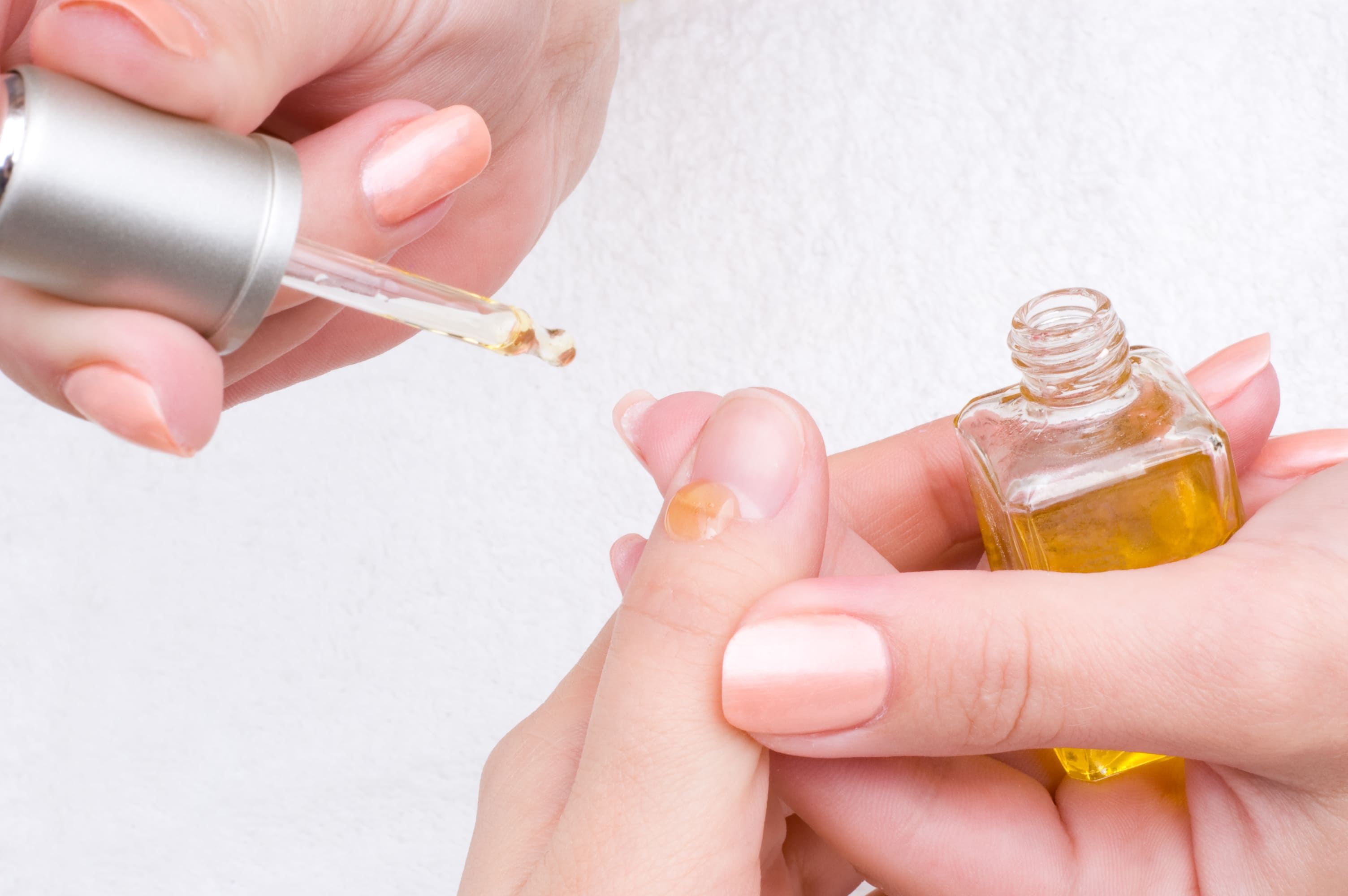
I’m not sure if you have seen these cuticle oil pens? They make it an easy way of applying and using cuticle oil with Jojoba oil for nails. You can easily obtain the empty pens, ready to fill yourself at home with your own formula. I’ll be sure to give you a couple of essential oil blends for these below.
A customer asked me last week, ‘Can I use cuticle oil for nails’? Yes of course you can! Smoosh it all over and under your nails at least twice a week.
More recipes here - How to Make Cuticle Oil with Essential Oils
Nail and Cuticle Cream

You can make the most luxurious and decadent nail and cuticle creams with Jojoba oil for nail care.
You can pack them full of protective waxes, unctuous cosmetic butters full of nourishing fatty acids and carrier oils oozing with Oleic and Linoleic Acids. Finish them with appropriate essential oils for a behemoth powerhouse combination.
The constituents will introduce moisture, attract it, lock it in alongside the oil molecules and protect your skin, nails and cuticles.
Often, cuticle creams are richer and thicker than hand creams, but not quite as thick and waxy as a nail and cuticle balm.
Nail And Cuticle Balms & Salves

I have to confess that these are my personal favourite as we head into the fall and winter months. Though, I find it most useful in seed sowing and potting up season where my bare hands are in and out of potting mix and compost all day. I use it to prevent wicklows and protect my cuticles and nails (and my gel lacquer shine and finish).
They make great nail strengtheners and skin protectors with their thick waxy finish and nourishing oils full of active constituents.
Hand Cream

Yes.. just plain old hand cream, laced with Jojoba oil for nails and cuticle care is sometimes all you need for daily maintenance. It is super easy to make your own hand cream at home and can be done quickly. It’s a fun project to do with a group of friends for a fun and chatty afternoon.
How to Make Hand Cream with Essential Oils
The Best Coconut Hand Cream Recipes On The Internet - Guaranteed!
Recipes With Jojoba Oils For Nails
I’ve created a selection of brand new recipes with Jojoba oil for nails, cuticles and your precious hands. I think you are going to love these for their ease and simplicity. Perfect for absolute beginners.
Three Essential Oil Blends For Jojoba Nail & Cuticle Oil Pens

Try one, or all of these exciting blends for nail and cuticle pens with Jojoba oil. Packed with carrier oils and essential oils to soften, moisturize and hydrate your nails and cuticles. The antioxidants will help in protecting from damage caused by environmental pollutants, daily dirt and grime and free radicals.
Choose the blend with Jojoba oil for nails and cuticles that suits you best.
Illustrating Image Of Cuticle Pen taken from Amazon
You Will Need For All Blends:
- Small measuring jug
- Stainless steel spoon
- Bottle funnel
- 50ml bottle with rubber topped dropper
- Oil and waterproof label
Optional: Natural preservative of your choice - consult the manufacturer’s instructions.
Blend To Support Nail Immunity

Ingredients
- 30 ml of Jojoba carrier oil (Simmondsia chinensis)
- 17 ml of Tamanu carrier oil (Calophyllum inophyllum L)
- 20 drops of Tea Tree essential oil (Melaleuca alternifolia)
- 20 drops of Roman Chamomile essential oil (Anthemis nobilis L.)
- 20 drops of Lavender essential oil (Lavandula angustifolia)
Safety:
-
Do not use it in the first 16 weeks of pregnancy
- Not suitable for children under 12 (Essential oil dilution rate)
Soothing and Strengthening Blend

Sometimes we need something a little ‘extra’ and this is it! We’ve combined Jojoba oil for nails with Avocado oil and Argan oil that are packed with Oleic and Linoleic acids.
The constituents in this formulation help to:
- Moisturize and hydrate the nails
- Promote growth
- Reduce brittleness, cracking and breakage
- Reduce cuticle damage and wicklows
- Strengthen nails
- Improve the appearance of the nails
- Lead to healthy and strong nails and cuticles
Ingredients:
- 30 ml of Jojoba carrier oil (Simmondsia chinensis)
- 10 ml of Avocado carrier oil (Persea gratissima)
- 7.5 ml of Argan carrier oil (Argania Spinosa)
- 15 drops of Patchouli essential oil (Pogostemon cablin)
- 15 drops of Rose Geranium essential oil (Pelargonium Roseum X Asperum)
- 15 drops of Helichrysum essential oil (Helichrysum splendida)
Safety:
- Do not use it in the first 16 weeks of pregnancy
- Not suitable for children under 12 (Essential oil dilution rate)
Moisturizing and Nourishing Blend

You can use this simple blend with Jojoba oil for nails every day for routine maintenance. It is super light, easily absorbed and can be applied ‘on the run’. This is the perfect blend for dropping into your purse to use when out and about.
Ingredients:
- 25 ml of Jojoba carrier oil (Simmondsia chinensis)
- 22.5 ml of Coconut MCT carrier oil (Cocos nucifera)
- 30 drops of Lavender essential oil (Lavandula angustifolia)
- 10 drops of Roman Chamomile essential oil (Anthemis nobilis L.)
- 6 drops of Ylang Ylang essential oil (Cananga odorata)
Safety:
- Do not use it in the first 37 weeks of pregnancy
- Not suitable for children under 12 (Essential oil dilution rate)
Method for all blends:
- This is super simple, measure out all of your carrier oils, add your essential oils and mix thoroughly to combine.
- Decant into your rubber topped dropper bottle use a funnel to keep the bottle clean and oil free. This helps your oil and waterproof label adhere better.
- List all the ingredients on your label along with any safety advice. Add a production date and an expiry date of 3-6 months.
How To Use Jojoba Nail & Cuticle Oil Pens:
- Always be sure to do a 24-48 hour patch test first.
- Simply apply one drop of oil to each finger and rub the oil into your cuticles.
- Cuticle oil is best used at night, where it has time to absorb and get to work effectively.
Protective Balm with Jojoba Oil For Nails and Cuticles

Ok, ok, I confess! I created this just for me. I’m so hard on my nails between gardening, cooking and formulating, that I soon found that only a gel finish over acrylics, lasted me the whole month!
I know! Acrylics! ME! I know! They damage your nails yada yada yada. I know!
My nail tech went on holiday and I missed TWO whole months of manicure and maintenance and I managed to pop two acrylics off in the wait for my nail tech. (Noooo… I could NOT go elsewhere! A good nail tech is sacred). So this Protective Balm was born, it got me through a sticky spot and it will get you through too.
It’s now up the Lottie (Allotment) and I shove my nails deep into it before I go anywhere near soil, compost, potting mix or water. I have to say it works an absolute treat!
I’m sure it will for you too.
You Will Need:
- Microwave proof jug
- Heatproof mat
- Weigh scales
- Stainless steel spoon
- Silicone spatula
- Jar funnel
- 100ml Wide mouth shallow tin or jar
- Oil and waterproof label
Ingredients:
- 20 grams of Beeswax (Cera alba)
- 20 grams of Shea Butter (Butyrospermum parkii)
- 40 ml of Jojoba carrier oil (Simmondsia chinensis)
- 10 ml of Tamanu carrier oil (Calophyllum inophyllum L)
- 10 ml of Rosehip carrier oil (Rosa Canina)
- 60 drops of Geranium essential oil (Pelargonium Graveolens)
- 15 drops of Thyme essential oil (Thymus vulgaris)
- 10 drops of Myrrh essential oil (Commiphora myrrha)
Safety:
- Do not use it in the first 37 weeks of pregnancy
- Not suitable for children (essential oil dilution rate)
Method:
- Place the beeswax in the microwave proof jug and set in the middle of the microwave. Heat for 30 second bursts until the wax is half melted.
- Then add the Shea Butter and heat again on 30 second bursts until the wax and butter are molten and fluid.
- Remove from the microwave and set on a heatproof mat and allow to cool for a couple of minutes.
- Add the carrier oils and mix thoroughly and allow to cool a little more.
- Then add your essential oils and give it a really good mix for a couple of minutes.
- Decant into a wide shallow jar or tin and cover with soft cotton cloth and allow to cool. Don’t let the cloth touch the surface of the balm.
- We let it cool because if we add the lid now it traps heat and moisture, which can create a perfect breeding ground for bacteria and mold…and we don’t want that.
- Let it cool fully and then add the lid and a label listing all ingredients, safety information, production date and expiry date of 3-6 months.
How To Use:
- Do that 24-48 patch test please.
- Scoop out some of the balm and rub it into the nails, cuticles and use it to protect underneath the fingernails too.
- Use as and when needed, up to 4 times a day. Though it is no substitute for rubber gloves!
The Final Word On Using Jojoba Oil For Nails

Thanks for joining me on this little foray into using Jojoba oil for nails and cuticles. I hope you’ve discovered what a fantastic ingredient Jojoba oil really is—and how it can support the care of your hands and nails.
By now, you should have a good understanding of how to use Jojoba oil for nails, and how to combine it with other carrier and essential oils to enhance its effects through their active constituents.
Hopefully, you’re feeling confident enough to try some of these homemade formulations yourself. Regular use of Jojoba oil can be a real treat for your nail and cuticle care routine. Try making nail and cuticle oil pens, serums, creams, balms, and salves.
If you’re curious to explore further, why not also check out our guide to Unlock Your Hair's Potential with Jojoba Oil
And if you do try a “Jojoba oil nails before and after” experiment, we’d love to see your results! Share your progress in the VINEVIDA Facebook Group—it’s a great place to swap tips and celebrate your DIY skincare wins.
Lastly, if Jojoba oil has made its way into your cart this week, don’t forget to explore other projects you can make with it—your hands, nails, and even hair will thank you.